


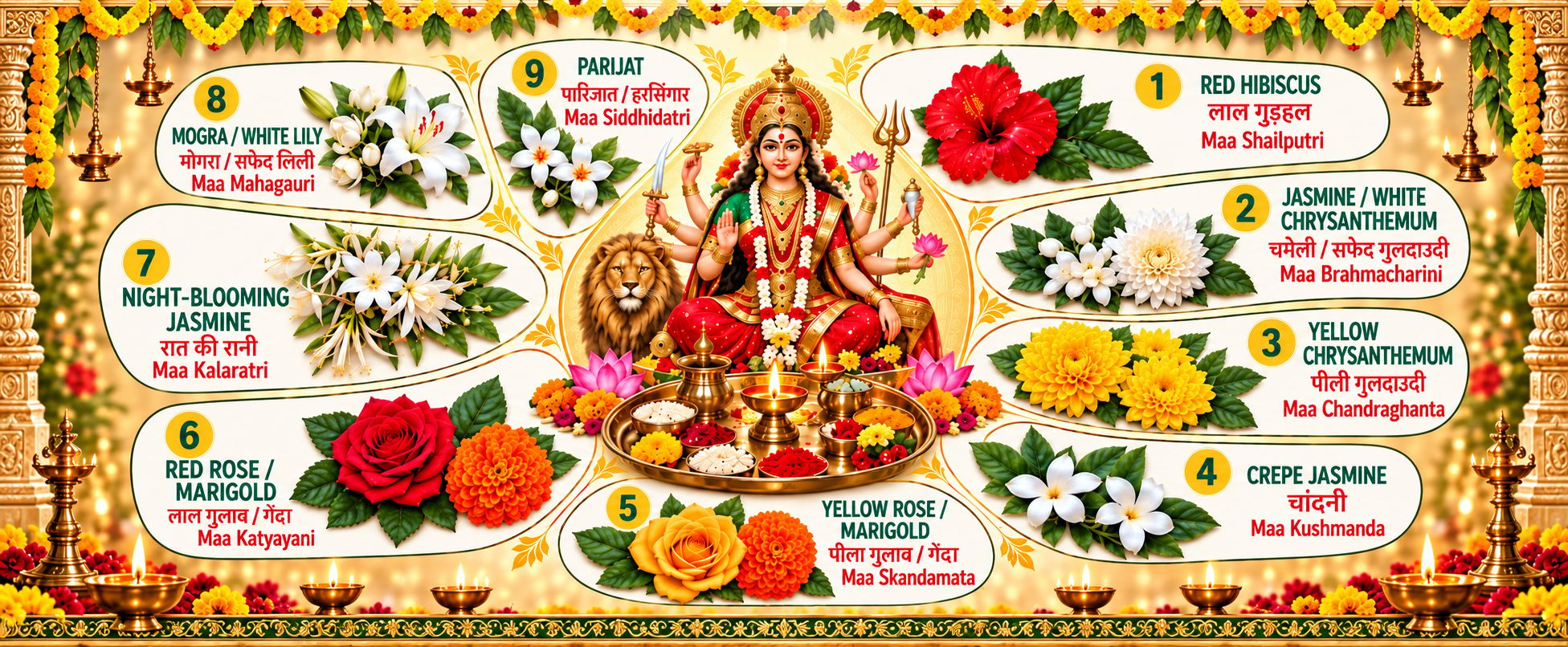
Read about the traditional Navratri flower offerings for each day, plus tips for choosing fresh blooms and growing your own puja flowers at home.
Key Takeaways
- Red Hibiscus (Gudhal/Japa Pushpa) is traditionally considered one of the most auspicious flowers offered to Goddess Durga. Its red colour is associated with devotion, Shakti, and divine energy.
- Marigold, Rose, Mogra, Parijat, Aparajita, Champa, Chrysanthemum, and Kaner are also used during Durga Puja and Dussehra based on regional traditions, family customs, and availability.
- Parijat (Shiuli/Harsingar) holds a special connection with Durga Puja in many regions, especially in eastern India. Its white flowers with orange centres are often collected in the morning and used for worship.
- Marigold is one of the most popular festive flowers used for garlands, torans, idol decoration, and puja arrangements during celebrations.
- Fresh flowers are generally preferred for offerings, but if a traditional flower is unavailable, many devotees use other fresh flowers while following their family traditions.
Before the first diya is lit, in many Indian homes, Navratri begins with a simple ritual: choosing fresh flowers for Maa Durga. Some pick from their gardens, while others go to a flower market to buy them.
The flowers do not have to be expensive or rare. What matters is the love and faith with which they are offered. During Navratri, different flowers are associated with the nine forms of Maa Durga. Their colours, fragrance, and even meanings reflect the qualities of each form of the Goddess.
Here, we will discuss which flower is commonly offered to Maa Durga on each day of Navratri. You will also learn what each flower represents and how you can offer it during your puja.
P.S. These traditions may differ from one state, family, or temple to another, so you can follow the practice that is followed in your home.
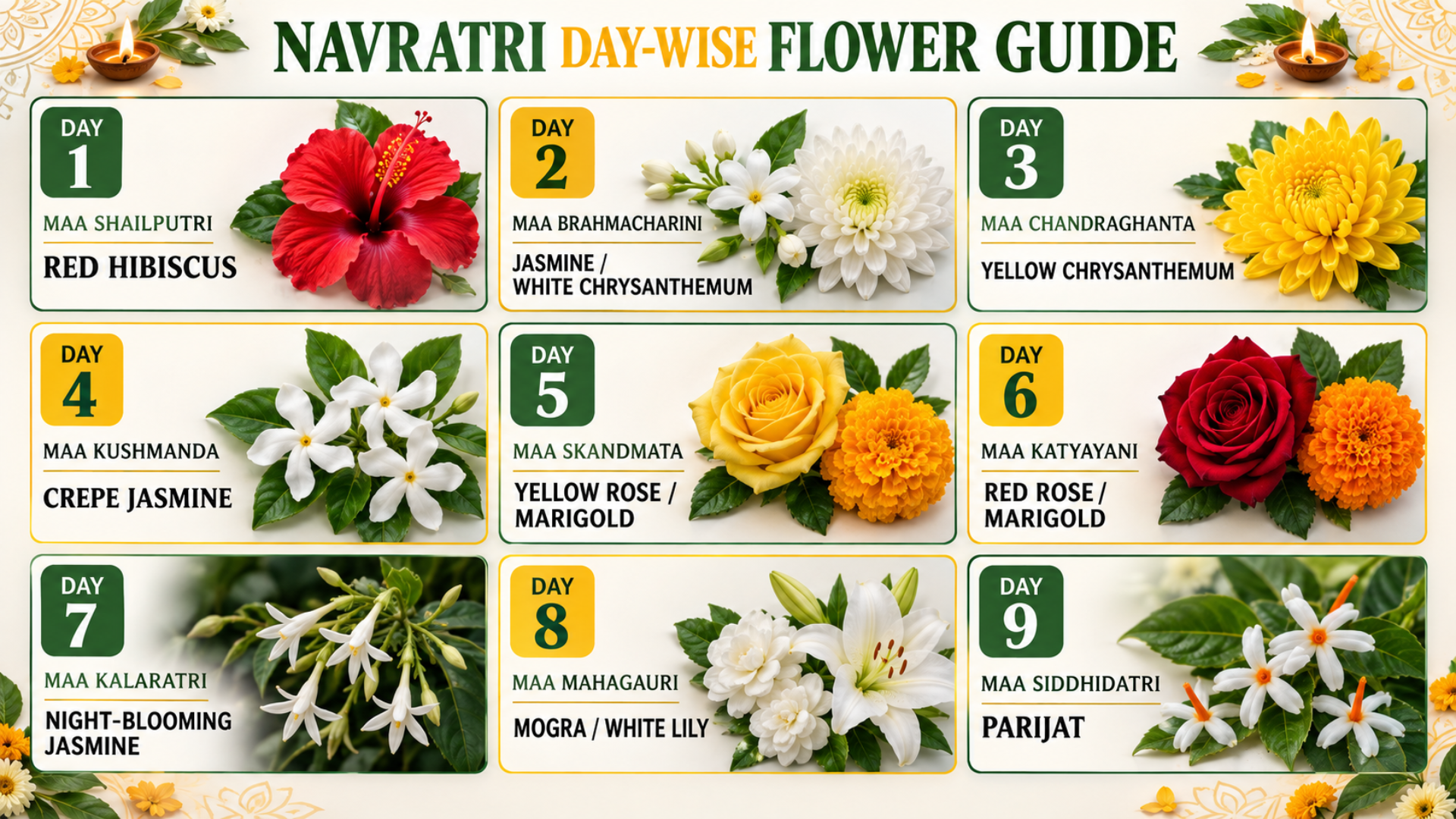
Quick Overview: Navratri Day-Wise Flower Guide
| Navratri | Goddess | Associated Flower | Flower Symbolism |
|---|---|---|---|
| Day 1 | Maa Shailputri | Red Hibiscus | Shakti, devotion, vitality |
| Day 2 | Maa Brahmacharini | Jasmine / White Chrysanthemum | Purity, peace, devotion |
| Day 3 | Maa Chandraghanta | Yellow Chrysanthemum | Auspiciousness, positivity, joy |
| Day 4 | Maa Kushmanda | Crepe Jasmine | Purity, simplicity, freshness |
| Day 5 | Maa Skandmata | Yellow Rose / Marigold | Warmth, auspiciousness, devotion |
| Day 6 | Maa Katyayani | Red Rose / Marigold | Love, devotion, strength |
| Day 7 | Maa Kalaratri | Night-Blooming Jasmine | Fragrance, beauty, devotion |
| Day 8 | Maa Mahagauri | Mogra / White Lily | Purity, peace, serenity |
| Day 9 | Maa Siddhidatri | Parijat | Grace, beauty, spiritual devotion |
NOTE: Flower associations can vary by region, family tradition, sampradaya, and local puja practice. This list represents commonly followed traditions rather than one universal scriptural rule.
Navratri Flowers Offered to Nine Forms of Goddess Durga
Day 1 (Maa Shailputri): Red Hibiscus (लाल गुड़हल)
: Red Hibiscus (लाल गुड़हल).png)
The first day of Navratri is dedicated to Maa Shailputri (माँ शैलपुत्री), the daughter of the mountain and the first form of Navdurga. She represents the beginning of the nine-day worship and is associated with strength, stability, and connection with nature.
Red Hibiscus, also called Gudhal or Jaswand, is one of the most commonly offered to Goddess Shailputri. The intense red colour of Hibiscus makes it especially popular in worship of forms of Devi and Shakti. It is also strongly associated with Goddess Kali in several Indian traditions.
If you're planning to grow one, our guide to caring for Hibiscus plants covers watering, sunlight, and pruning tips to keep it flowering through the festival season.
Practical tip: Choose flowers that are fresh and free from insects, dust, and visible damage.
Day 2 (Maa Brahmacharini): Jasmine (चमेली)/ White Chrysanthemum (सफेद गुलदाउदी)
: Jasmine (चमेली.png)
Maa Brahmacharini is worshipped on the second day of Navratri. She represents penance, devotion, patience, and spiritual discipline. In Hindu tradition, Brahmacharini (मां ब्रह्मचारिणी) is associated with Parvati’s period of austerity and penance before her marriage to Lord Shiva.
Jasmine (चमेली) and White Chrysanthemum (सफेद गुलदाउदी) are traditionally associated with her worship in some Navratri traditions. Jasmine is valued for its white colour and fragrance. White chrysanthemum, also known as Shevanti or Guldaudi in different parts of India, is another flower used in offerings.
Since Navratri flower traditions can vary by region and family, either fresh Jasmine or White Chrysanthemum can be offered according to the custom you follow.
Both are easy to grow at home. Mogra is fragrant and low-maintenance, while chrysanthemum blooms around Navratri and Diwali. See our guides on growing Mogra and Chrysanthemum care.
Day 3 (Maa Chandraghanta): Yellow Chrysanthemum (पीला गुलदाउदी)
: Yellow Chrysanthemum (पीला गुलदाउदी).png)
The third day of Navratri is dedicated to Maa Chandraghanta (मां चंद्रघंटा), a form of Goddess Parvati depicted with a crescent moon shaped like a bell on her forehead. She is associated with courage, strength, and protection.
Yellow Chrysanthemum (पीला गुलदाउदी) is associated with Maa Chandraghanta due to Its bright yellow colour, which reflects auspiciousness and energy.
Practical tip:Choose fresh, clean blooms without wilted or damaged petals. If Yellow Chrysanthemum is unavailable, you can follow your family's usual flower offering tradition rather than using an unsuitable flower simply to match a day-wise list.
Day 4 (Maa Kushmanda): Crepe Jasmine (क्रेप जैस्मी)
: Crepe Jasmine (क्रेप जैस्मी).png)
On the fourth day, devotees worship Maa Kushmanda (माँ कूष्माण्डा), one of the nine forms of Navdurga. She is traditionally described as the Goddess associated with cosmic creation and linked to the radiance of the Sun.
Crepe Jasmine, also known as Chandni or Tagar, is one of the flowers traditionally offered to Maa Kushmanda during Day 4 of Navratri. Its small, white, pinwheel-shaped blooms are linked with purity and light, making it a fitting choice for her worship.
If you cannot find Crepe Jasmine, regular jasmine, also known as Mogra or Chameli, is another flower used for her worship in some traditions.
Day 5 (Maa Skandmata): Yellow Rose (पीला गुलाब)/Marigold (गेंदा)
: Yellow Rose (पीला गुलाब)Marigold (गेंदा).png)
The fifth day of Navratri is dedicated to Maa Skandmata (माँ स्कंदमाता), the mother of Lord Skanda, also known as Kartikeya. She is commonly depicted holding Skanda and seated on a lotus. Maa Skandmata represents motherhood, compassion, strength, and protection.
Yellow Roses and Marigolds are traditionally associated with Maa Skandmata and are used for her worship on Day 5 of Navratri. Yellow flowers are traditionally chosen for their bright, warm appearance.
Both are easy to grow at home for daily puja. Roses need sun and pruning, while Marigolds are fast-growing and low-maintenance. See our Rose plant care guide and Marigold growing guide.
Day 6 (Maa Katyayani): Red Rose (लाल गुलाब)/Marigold (गेंदा)
: Red Rose (लाल गुलाब)Marigold (गेंदा).png)
The sixth day of Navratri is dedicated to Maa Katyayani (माता कात्यायिनी), a powerful form of Goddess Durga associated with courage, strength, and the defeat of evil. She is traditionally depicted as a warrior goddess. Maa Katyayani is associated with strength, courage, and protection.
Red is also traditionally associated with her worship, making red flowers a popular choice for this day. Marigold (genda) is a widely used devotional flower that is specifically mentioned as an offering for Katyayani in several puja traditions.
Day 7 (Maa Kalratri): Night Blooming Jasmine (रात की रानी)
: Night Blooming Jasmine (रात की रानी).png)
The seventh day of Navratri is dedicated to Maa Kalaratri(माँ कालरात्रि), the fierce form of Goddess Durga. Despite her formidable appearance, she is worshipped as a protective and auspicious form of Devi who is believed to remove fear and overcome negative forces.
Night-Blooming Jasmine, commonly known as Raat Ki Rani, is traditionally associated with Maa Kalaratri and is offered during Day 7 of Navratri. The flowers are small, pale yellowish-white, and known for their strong fragrance, which becomes more noticeable after dusk.
Because flower offerings can vary across regions and family traditions, this association should be understood as a traditional practice rather than a universal scriptural rule.
Pro tip: Offer fresh, clean flowers and avoid using wilted or damaged blooms. If night-blooming jasmine is unavailable, follow the flower offering traditionally used in your family or local Devi puja.
Day 8 (Maa Mahagauri): Mogra (मोगरा)/White Lily (सफेद कुमुदिनी)
: Mogra (मोगरा)White Lily (सफेद कुमुदिनी).png)
The eighth day of Navratri is dedicated to Maa Mahagauri (माँ महागौरी), a form of Goddess Parvati associated with purity, peace, and serenity. She is traditionally depicted with a fair or radiant complexion and is worshipped for blessings of calmness and spiritual purity.
Mogra, or Arabian Jasmine, and White Lily are traditionally associated with Maa Mahagauri in some Navratri flower traditions. Both are white flowers, making them a natural choice for worship associated with purity and tranquillity. Mogra is also valued for its pleasant fragrance, while White Lilies add a simple and elegant appearance to the puja altar.
For those growing flowers at home, Mogra and White Lily can both be part of a simple puja garden. White Lily is a low-maintenance bulb plant that can add variety to your collection. See our Lily plant care guide.
Day 9 (Maa Siddhidatri): Parijat (पारिजात)
: Parijat (पारिजात).png)
The ninth and final day of Navratri is dedicated to Maa Siddhidatri (माता सिद्धिदात्री), the ninth form of Navdurga. She is traditionally worshipped as the Goddess who bestows siddhis, spiritual wisdom, fulfillment, and divine blessings.
Parijat (पारिजात), also known as Harsingar or Harshringar, is traditionally associated with Maa Siddhidatri and is offered on Day 9 of Navratri. In Bengal and parts of eastern India, the flower is also known as Shiuli or Sheuli.
Parijat is easy to recognize by its small white petals and distinctive orange or saffron centre. It has a sweet fragrance and blooms at night, with many of its flowers naturally falling by morning.
What Should You Look For When Buying Flowers for Navratri Puja?
Freshness matters more than buying a large quantity.
Look for flowers that have:
- Fresh, firm petals
- Natural colour
- A clean appearance
- No mould or decay
- No obvious insect damage
- No strong chemical or artificial fragrance
Avoid using flowers that are wilted, rotten, heavily bruised, or covered with dirt.
Can You Grow Your Own Navratri Puja Flowers?
Yes. You can grow the flowers for Navratri Puja. Choose plants that suit the space you have, provide the right amount of sunlight and water, and care for them according to their needs. With the right timing, your home garden can provide fresh flowers for Navratri worship.
| Your Space | Plants to Consider |
|---|---|
| Sunny balcony | Marigold, Hibiscus |
| Bright space with support | Jasmine |
| Container garden | Chrysanthemum, Rose |
| Larger garden | Parijat |
If you want to grow your own Navratri flowers, starting with healthy nursery-grown plants purchased online from a reliable store such as Urvann can be a convenient option. Established plants give you a head start on growing and caring for flowering plants at home. You can explore a range of flowering plants online at Urvann and choose varieties that suit your space and growing conditions.
If you're in Bengaluru, explore Urvann's plants in Bengalore. For Delhi and nearby NCR areas, browse Urvann's plants in Delhi.
Frequently Asked Questions (FAQs)
1. Can Marigold be used for pooja every day of Navratri?
Yes. Marigold is one of the most versatile and widely available Navratri flowers, and it is commonly used as a general offering across multiple days, even on days when a different flower is traditionally assigned to that Goddess form. For example, it can be used when hibiscus, yellow rose, or yellow chrysanthemum is not available. It is a practical and widely accepted choice when you cannot source the specific flower for that day.
2. Is it necessary to use a different flower each day?
Not strictly. The day-by-day flower assignments come from tradition and symbolism rather than a fixed religious rule. Many households simplify their offerings by using one or two easily available flowers, most commonly marigold and rose, throughout the nine days instead of sourcing a different flower daily.
3. What can I substitute if a fresh flower is not available?
Marigold and Rose are two widely available options that can be used when a specific flower is difficult to source. For harder-to-find flowers in this list, such as Parijat, Crepe Jasmine, or night-blooming Jasmine, the alternative may depend on the tradition followed for that particular Goddess. Where no specific alternative is established, flower offerings can vary according to regional and family customs.
4. Which flowers should not be used for pooja?
There is no single universal list of flowers that are forbidden across all Hindu traditions. However, wilted, stale, damaged, or unclean flowers are generally avoided for puja. Rules concerning particular flowers, buds, or plants can vary by deity, region, and tradition, so follow the practice customary in your household or temple.
5. What is Maa Durga's favourite flower overall?
Red hibiscus is strongly associated with Devi and Shakti worship in several Indian traditions, including worship of Goddess Durga and Kali. However, there is no single universally prescribed "favourite flower" of Maa Durga across all Hindu traditions.
6. Do the flowers differ by region?
Yes. Flower-to-day assignments are not identical everywhere. Different sources and traditions may recommend different flowers for the same form of Goddess Durga. Bengali Durga Puja, for example, has its own regional customs and flower offerings. Family traditions and local temple practices can also influence which flowers devotees use during Navratri.
7. Can I use flowers grown at home?
Yes, you can use flowers grown at home for puja. In fact, offering freshly picked flowers from your own garden can make the ritual feel more personal. To keep your flowering plants healthy, provide them with the right amount of sunlight, water, well-draining soil, and occasional fertilization. Pick fresh, clean, fully opened flowers without using flowers that are wilted, damaged, or fallen on the ground.
8. How to keep Navratri flowers fresh?
If you buy flowers before the puja, keep them in a cool place away from direct sunlight and heat. Avoid crushing or tightly packing delicate flowers, as this can damage the petals. For the freshest appearance, use the flowers as soon as possible. Before the puja, gently remove damaged or wilted blooms and offer only clean, fresh flowers.
9. ನವರಾತ್ರಿ ಪೂಜೆಗೆ ಎಷ್ಟು ಹೂವುಗಳು ಬೇಕು?
ನವರಾತ್ರಿ ಪೂಜೆಗೆ ಅಗತ್ಯವಿರುವ ಹೂವುಗಳ ಯಾವುದೇ ನಿಗದಿತ ಸಂಖ್ಯೆ ಇಲ್ಲ. ಹೂವುಗಳ ಪ್ರಮಾಣವು ನಿಮ್ಮ ಕುಟುಂಬದ ಸಂಪ್ರದಾಯ ಮತ್ತು ನೀವು ಮಾಡುವ ಪೂಜೆಯ ವಿಧಾನದ ಮೇಲೆ ಅವಲಂಬಿತವಾಗಿರುತ್ತದೆ. ಸರಳವಾದ ಮನೆಯ ಪೂಜೆಗೆ, ನೈವೇದ್ಯ ಮತ್ತು ಮೂಲ ಅಲಂಕಾರಕ್ಕೆ ಒಂದು ಸಣ್ಣ ಹಿಡಿಯಷ್ಟು ತಾಜಾ ಹೂವುಗಳು ಸಾಮಾನ್ಯವಾಗಿ ಸಾಕಾಗುತ್ತವೆ. ಹೂವಿನ ಹಾರಗಳನ್ನು ತಯಾರಿಸುತ್ತಿದ್ದರೆ ಅಥವಾ ದೊಡ್ಡ ಪೂಜಾ ಸ್ಥಳವನ್ನು ಅಲಂಕರಿಸುತ್ತಿದ್ದರೆ, ಹೆಚ್ಚು ಹೂವುಗಳು ಬೇಕಾಗಬಹುದು.
10. ನವರಾತ್ರಿಗಾಗಿ ಹೂಬಿಡುವ ಗಿಡಗಳನ್ನು ಆನ್ಲೈನ್ನಲ್ಲಿ ಎಲ್ಲಿ ಖರೀದಿಸಬಹುದು?
ನವರಾತ್ರಿ ಪೂಜೆಗಾಗಿ ಹೂಬಿಡುವ ಗಿಡಗಳನ್ನು Urvann ನಲ್ಲಿ ಆನ್ಲೈನ್ನಲ್ಲಿ ಖರೀದಿಸಬಹುದು. ದಾಸವಾಳ, ಮಲ್ಲಿಗೆ, ಚೆಂಡು ಹೂವು, ಗುಲಾಬಿ, ಸೇವಂತಿಗೆ ಮತ್ತು ಪಾರಿಜಾತ ಮುಂತಾದ ಹೂಬಿಡುವ ಗಿಡಗಳನ್ನು ಆಯ್ಕೆ ಮಾಡಬಹುದು. ಆನ್ಲೈನ್ನಲ್ಲಿ ಗಿಡಗಳನ್ನು ಖರೀದಿಸುವಾಗ ಆರೋಗ್ಯಕರವಾಗಿ ಬೆಳೆದ, ಉತ್ತಮ ಬೇರುಗಳನ್ನು ಹೊಂದಿರುವ ಗಿಡಗಳನ್ನು ಆಯ್ಕೆಮಾಡಿ ಮತ್ತು ನಿಮ್ಮ ಪ್ರದೇಶಕ್ಕೆ ಡೆಲಿವರಿ ಲಭ್ಯವಿದೆಯೇ ಎಂಬುದನ್ನು ಪರಿಶೀಲಿಸಿ.