


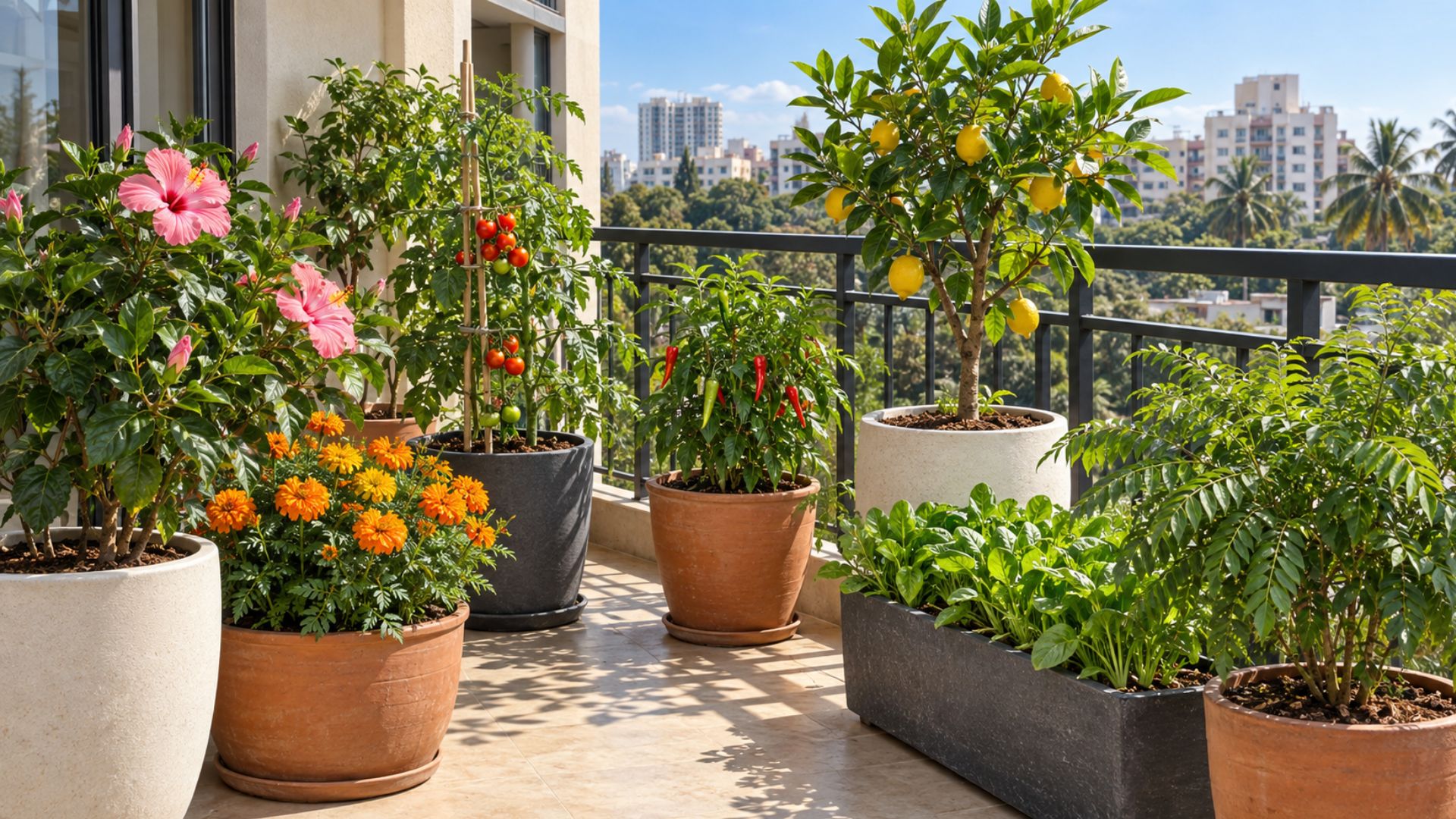
A complete guide to Bangalore balcony plants with direct sun, covering flowering plants, vegetables, fruit plants, and low-maintenance varieties.
Key Takeaways
-
-
- 6+ hours of direct sunlight? Choose heat-loving plants like Bougainvillea, Portulaca, and Aloe Vera that can handle strong sun.
- West-facing balconies receive harsh afternoon heat, so choose resilient plants like Vinca, Lantana, and Agave.
- South-facing balconies support a wider variety of plants, including flowering plants, vegetables, and fruit plants like Tomato, Chilli, Lemon, and Bougainvillea.
- Choose plants based on your goal: Hibiscus for regular blooms, Bougainvillea for large flowers, and Vinca for low-maintenance colour.
- Sunny balconies can also become productive gardens with vegetables like Tomato, Chilli, Okra, and Brinjal grown in containers.
- Bangalore’s seasons affect plant growth. Protect plants from summer heat, maintain drainage during monsoon, and start new plants during winter.
- For easy-care greenery, choose hardy plants like Aloe Vera, Snake Plant, Jade Plant, and Agave.
-
You look at your Bangalore balcony and imagine a small green space filled with plants, flowers, and fresh greenery.
But creating a balcony garden is not always as simple as it looks.
You provide sunlight and regular care, yet some plants still struggle. Leaves turn brown, flowers stop blooming, and you are left wondering what went wrong.
The reason is that every Bangalore balcony has different growing conditions. A west-facing balcony can experience harsh afternoon heat, while seasonal changes from dry summers to humid monsoons can affect how plants grow.
A sunny balcony does not mean every plant will thrive there. The key is choosing plants that match your balcony's sunlight, climate, and growing conditions.
In this guide, we will explore flowering plants, vegetables, fruit plants, and low-maintenance greenery that can truly thrive on a Bangalore balcony with direct sun.
Best Plants for Every Type of Bangalore Balcony: Quick Reference
| Balcony Type | Best Flowering Plants | Best Vegetables | Best Low Maintenance Plants |
|---|---|---|---|
| South-facing, full sun (+6 hrs) | Bougainvillea, Lantana, Portulaca, Gaillardia | Tomato, Chilli, Okra, Brinjal | Aloe Vera, Agave, Jade Plant |
| West-facing, harsh afternoon sun | Portulaca, Vinca, Lantana | Chilli, Curry Leaf | Aloe Vera, Snake Plant, Agave |
| East-facing, morning sun (3-5 hrs) | Hibiscus, Marigold, Zinnia | Mint, Coriander, Spinach | Money Plant, Spider Plant, Snake Plant |
| Large terrace garden | Bougainvillea, Oleander, Plumeria | Tomato, Brinjal, Okra, Beans | All succulents, Ficus, Curry Leaf tree |
| Small apartment balcony | Vinca, Portulaca, Marigold | Chilli, Mint, Curry Leaf | Snake Plant, Aloe Vera, Jade Plant |
NOTE: Before choosing plants, check your balcony's sun hours, direction, and seasonal conditions. A west-facing balcony requires more heat-tolerant plants, while south-facing balconies support a wider variety.
What Does "Full Sun" Actually Mean for Balcony Plants?
Before anything else, this is worth clearing up because it causes more confusion than any other gardening term.
- Full sun means a spot that receives 6 or more hours of direct, unfiltered sunlight per day. Not bright light through a curtain. Not reflected light from a white wall. Direct sun rays falling on the leaves.
- Partial sun means 4 to 6 hours of direct sunlight.
- Partial shade means 2 to 4 hours of direct sun, usually morning light.
Most sun-loving plants need a minimum of 5 to 6 hours of direct sunlight to flower or fruit properly. Some, like Bougainvillea and Portulaca, want 6 to 8 hours and produce poorly with anything less.
How to check: Pick a typical clear day and note when direct sunlight first hits your balcony and when it moves away. That gap is your sun hours. Do this in both summer and winter because the angle of the sun changes, and some balconies that get 8 hours in April get only 4 in December.
How Much Sun Does Your Bangalore Balcony Actually Get?
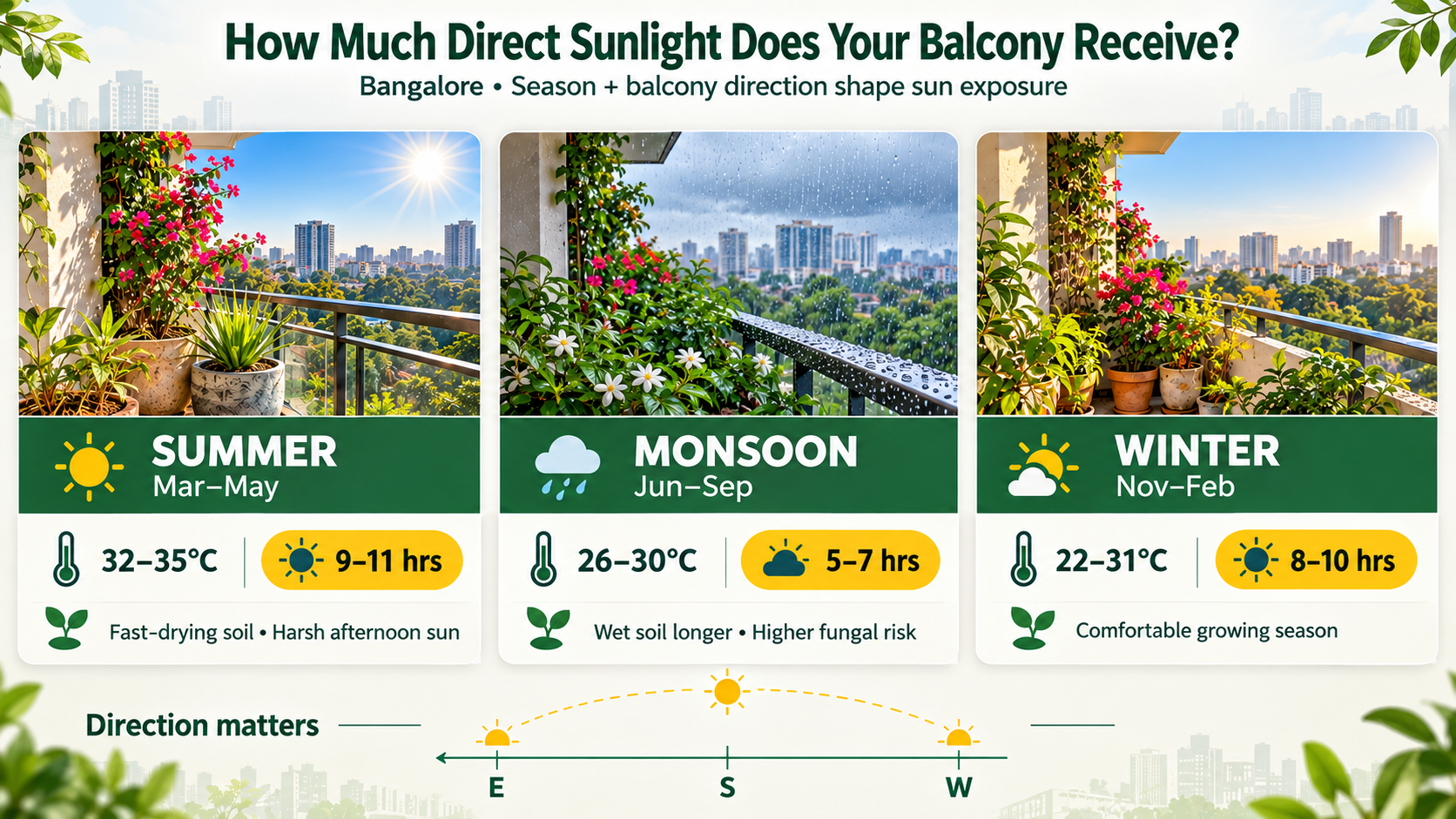
Bangalore sits in a tropical savanna zone with a moderate climate. The sunlight your balcony receives depends on two things: the season and the direction your balcony faces.
Sunlight by Season
| Season | Months | Temperature Range | Direct Sunlight Hours | What This Means for Plants |
|---|---|---|---|---|
| Summer | March to May | 32°C to 35°C (April is the hottest month) | 9 to 11 hours per day | Soil dries fast, small pots overheat, afternoon sun is harsh |
| Monsoon | June to September | 26°C to 30°C | 5 to 7 hours per day (heavy cloud cover) | Humidity is high, soil stays wet longer, fungal risk increases |
| Winter | November to February | 22°C to 31°C | 8 to 10 hours per day | The most comfortable growing season; almost every plant does well |
Which Direction Is Best for Balcony Plants?
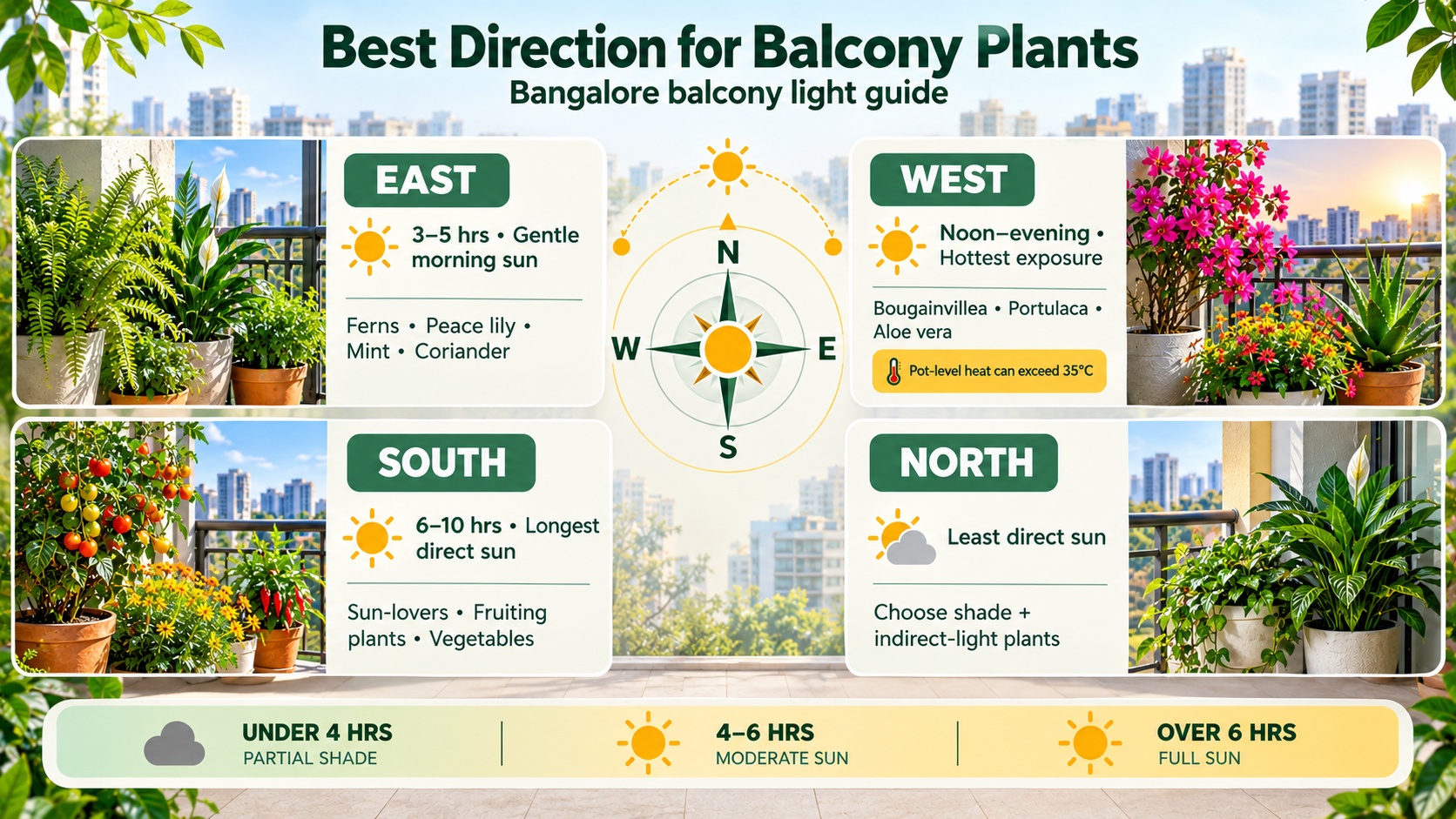

This is the part most guides skip entirely. Two balconies in the same Bangalore apartment building can have completely different growing conditions depending on which direction they face.
East-Facing Balcony
Sun Exposure: 3–5 hours of morning sunlight
Best-suited plants:
- Hibiscus
- Marigold
- Mint
- Coriander
- Spider Plant
West-Facing Balcony
Sun Exposure: Strong afternoon sunlight
Best suited plants:
- Portulaca
- Vinca
- Aloe Vera
- Lantana
- Agave
Avoid sensitive plants that struggle with afternoon heat.
South-Facing Balcony
Sun Exposure: 6–10 hours of sunlight
Suitable for:
- Bougainvillea
- Tomato
- Chilli
- Lemon
- Flowering plants
North-Facing Balcony
Sun Exposure: Receives the least direct sunlight.
Choose:
- Shade-tolerant plants
- Indoor-friendly greenery
- Indirect-light plants
Quick rule: Count the hours of direct sunlight your balcony gets on a typical clear day. Under 4 hours means partial shade. 4 to 6 hours means moderate sun. Over 6 hours means full sun. The plants in this guide are picked for balconies in the moderate to full sun range.
Best Flowering Plants for a Sunny Balcony in Bangalore
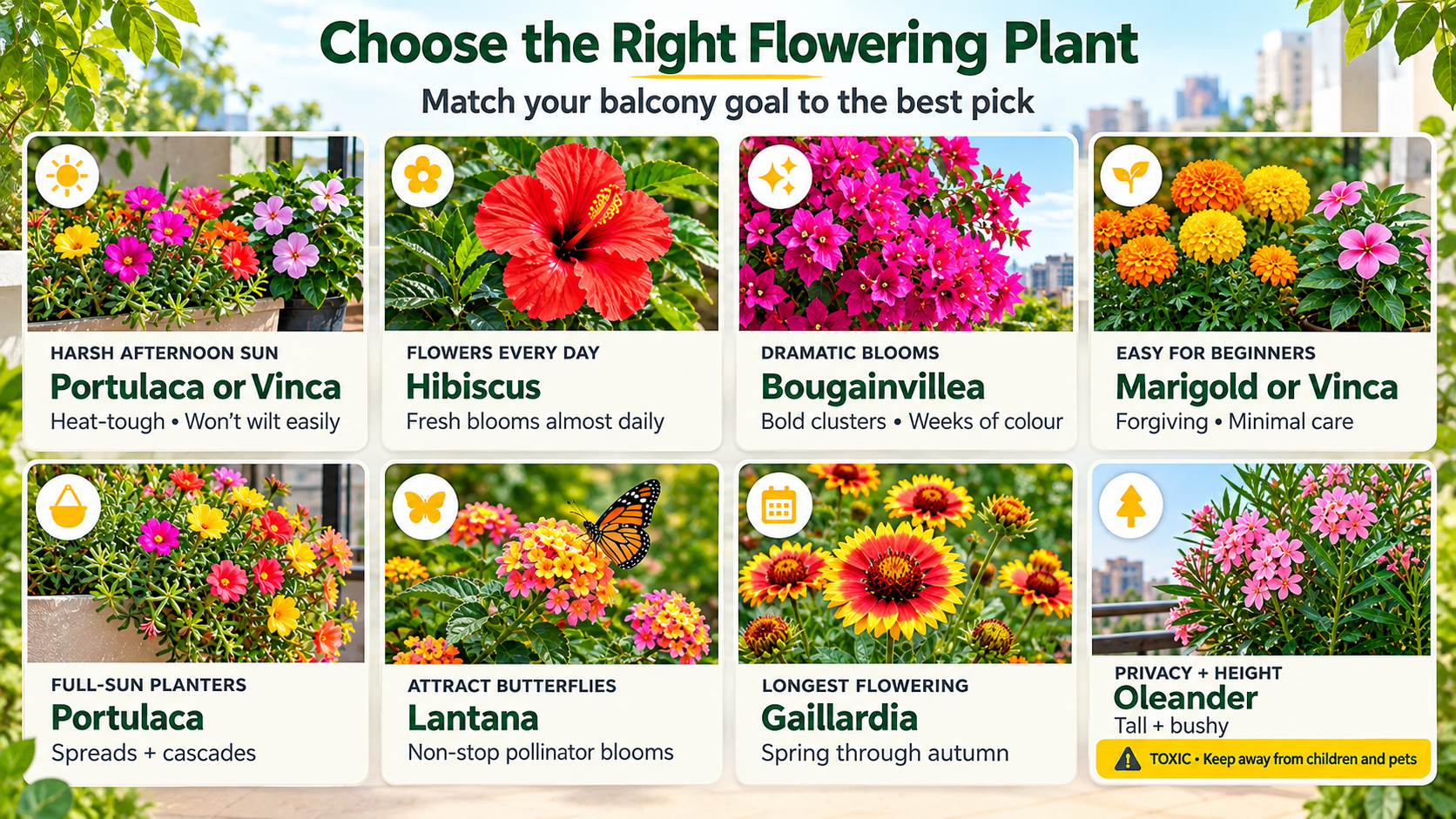
Flowering plants are the main reason most people start a balcony garden. These are the ones that reliably bloom on a Bangalore balcony with direct sun, along with what you actually need to know to keep them alive.
1. Bougainvillea (कागज़ का फूल/ಕಾಗದಹೂ)
The most reliable flowering plant for a sunny Bangalore balcony. Bougainvillea does not just tolerate direct sun; it needs it. Plants that get less than 5 to 6 hours of direct light produce leaves but very few flowers.
- Sunlight: 6 to 8 hours of direct sun, minimum
- Pot size: Choose a spacious planter as Bougainvillea develops strong roots and performs better when it has enough room to grow
- Watering: Let the soil dry out between waterings. Overwatering is the single biggest reason bougainvillea stops blooming
- Bangalore tip: Does exceptionally well on west-facing and south-facing balconies. Prune after each blooming cycle to push new flower growth
- Seasons: Blooms best in summer and winter. Flowering slows during the monsoon due to reduced sunlight
2. Hibiscus (गुड़हल/ದಾಸವಾಳ)
Hibiscus produces new flowers almost daily during warm months, which makes it one of the most satisfying balcony plants to grow. The catch is that Hibiscus is a heavier feeder than most potted plants and needs regular fertilizing to keep blooming.
- Sunlight: 5 to 6 hours direct sun
- Pot size: Use a medium to large container depending on the variety. Hibiscus performs best when its roots have enough space to support continuous flowering
- Watering: Consistent moisture, but not waterlogged. Water when the top inch of soil feels dry
- Bangalore tip: Watch for mealybugs during monsoon. The combination of humidity and dense foliage makes hibiscus a magnet for pests in June to August
- Seasons: Blooms through summer and monsoon. Growth slows slightly in December and January
3. Vinca / Sadabahar (Periwinkle/ನಿತ್ಯಪುಷ್ಪ))
If you want a flower plant for your balcony that survives Bangalore's hottest weeks with almost no attention, Vinca is the answer. It handles drought, heat, poor soil, and neglect better than almost any other flowering plant.
- Sunlight: Full sun, 6+ hours
- Pot size: A small to medium container is sufficient. Ensure good drainage to prevent root problems
- Watering: Very low water needs. Overwatering kills Vinca faster than underwatering
- Bangalore tip: Perfect for west-facing balconies where other flowers give up. Replace every 8 to 10 months as the plant gets woody and stops flowering well
- Seasons: Blooms year-round in Bangalore's climate. One of the few plants that flowers in every season without a break
4. Portulaca (Moss Rose/नौ बजे का फूल/ಪೋರ್ಟುಲಾಕಾ)
Portulaca is built for exactly the conditions most people complain about: intense sun, fast-draining soil, and infrequent watering. The flowers of the Moss Rose plant close up on cloudy days and open wide in bright sunlight.
- Sunlight: Full sun, the more the better. This plant can tolerate full sun all day without wilting
- Pot size: A shallow container works well because Portulaca does not require deep soil and spreads naturally
- Watering: Once every 2 to 3 days in summer, less during monsoon
- Bangalore tip: Grows flat and spreads, so it works well in wide, shallow planters or hanging baskets that get maximum sun exposure
- Seasons: Best performance from February to June. Dies back or gets leggy during prolonged monsoon rains
5. Marigold (गेंदा/ಚೆಂಡು ಹೂವು)
Marigolds are one of the easiest flowering plants to grow from seed on a Bangalore balcony. Marigolds grow fast, bloom within 45 to 60 days of sowing, and attract pollinators that benefit your other plants.
- Sunlight: 5 to 6 hours of direct sun
- Pot size: Use a medium container that provides enough space for healthy root growth
- Watering: Moderate and regular. Marigolds do not like dry soil the way Portulaca does
- Bangalore tip: Sow seeds directly in the pot rather than buying transplants. They establish faster and bloom heavier
- Seasons: Best sown in October for winter blooming, or in February for a summer display. Struggles in heavy monsoon rain
6. Lantana (लैंटाना/ಲಂಟಾನಾ)
Lantana is one of those plants that grows so well in Bangalore that it almost takes care of itself. Lantana’s flowers are in clusters of orange, yellow, white, and red, and it blooms non-stop through summer and monsoon. Butterflies are drawn to it, which makes it a good pick if you want a lively balcony.
- Sunlight: 6+ hours of direct sun
- Pot size: Choose a spacious container as Lantana grows quickly and needs room to spread
- Watering: Low water needs once established. Drought-tolerant
- Bangalore tip: Lantana grows aggressively. Prune it regularly, or it will take over the pot and crowd out neighbouring plants. Keep it in its own container
- Seasons: Flowers almost year-round in Bangalore. Peak bloom in summer
7. Gaillardia (गैलार्डिया/ಗೈಲಾರ್ಡಿಯಾ)
Gaillardia is a heat-loving perennial that does well across South India. The daisy-like flowers in red and yellow last a long time, and the plant keeps producing new ones for months.
Gaillardia can be grown either from seeds or as an established Gaillardia plant. Growing it from seeds allows you to enjoy the complete growing journey, while established plants are useful when you want quicker flowering and a mature-looking balcony garden.
- Sunlight: Full sun, 6+ hours
- Pot size: A medium container works well and provides enough space for healthy growth and flowering
- Watering: Low to moderate. Tolerates dry spells well
- Bangalore tip: Deadhead regularly (remove spent flowers) to keep the plant pushing out new blooms. Does not need rich soil — standard potting mix works
- Seasons: Blooms from spring through autumn. One of the longest flowering seasons of any balcony plant
8. Zinnia (जीनिया/ಜಿನ್ನಿಯಾ)
Another fast-growing flower that does well in direct Bangalore sun. Zinnias come in a wide range of colours and bloom for 6 to 8 weeks from a single sowing.
- Sunlight: Full sun, 6+ hours
- Pot size: Use a medium container with good drainage to support healthy growth and blooming
- Watering: Regular watering at the base. Avoid wetting the leaves, which invites powdery mildew
- Bangalore tip: Deadhead spent flowers regularly to keep new blooms coming. The plant stops producing once it sets seed
- Seasons: Best performance in summer (March to May). Can also be sown in early winter
9. Oleander (Kaner/कनेर/ಕಣಗಿಲು)
Oleander produces clusters of pink, white, or red flowers and handles extreme heat and sun without flinching. Oleander grows into a tall, bushy plant and works well as a balcony screen or privacy hedge in large planters.
- Sunlight: 6+ hours of full sun
- Pot size: Use a large, stable planter as Oleander grows tall and can become top-heavy over time
- Watering: Moderate. Surprisingly drought-tolerant once established
- Bangalore tip: Oleander performs well year-round in Bangalore's climate
- ⚠️ Important warning: All parts of the oleander plant are toxic to humans and animals. Do not grow this on a balcony where children or pets have unsupervised access. Wash hands after pruning.
Quick Comparison: Which Flowering Plant for Your Balcony?
| Your Situation | Best Pick | Why |
|---|---|---|
| West-facing balcony with harsh afternoon sun | Portulaca or Vinca | Both handle extreme heat without wilting |
| Want flowers every single day | Hibiscus | Produces a new bloom almost daily |
| Biggest, most dramatic blooms | Bougainvillea | Heavy flowering clusters that last for weeks |
| First-time gardeners, low effort | Marigold or Vinca | Easy to grow, forgiving, minimal care |
| Hanging basket or balcony planters in full sun | Portulaca | Spreads flat, cascades over edges |
| Want to attract butterflies | Lantana | Flowers non-stop and draws pollinators |
| Longest flowering season | Gaillardia | Blooms from spring through autumn |
| Need a large plant or privacy screen | Oleander | Grows tall and bushy (keep away from children and pets) |
Vegetables You Can Grow on a Sunny Bangalore Balcony
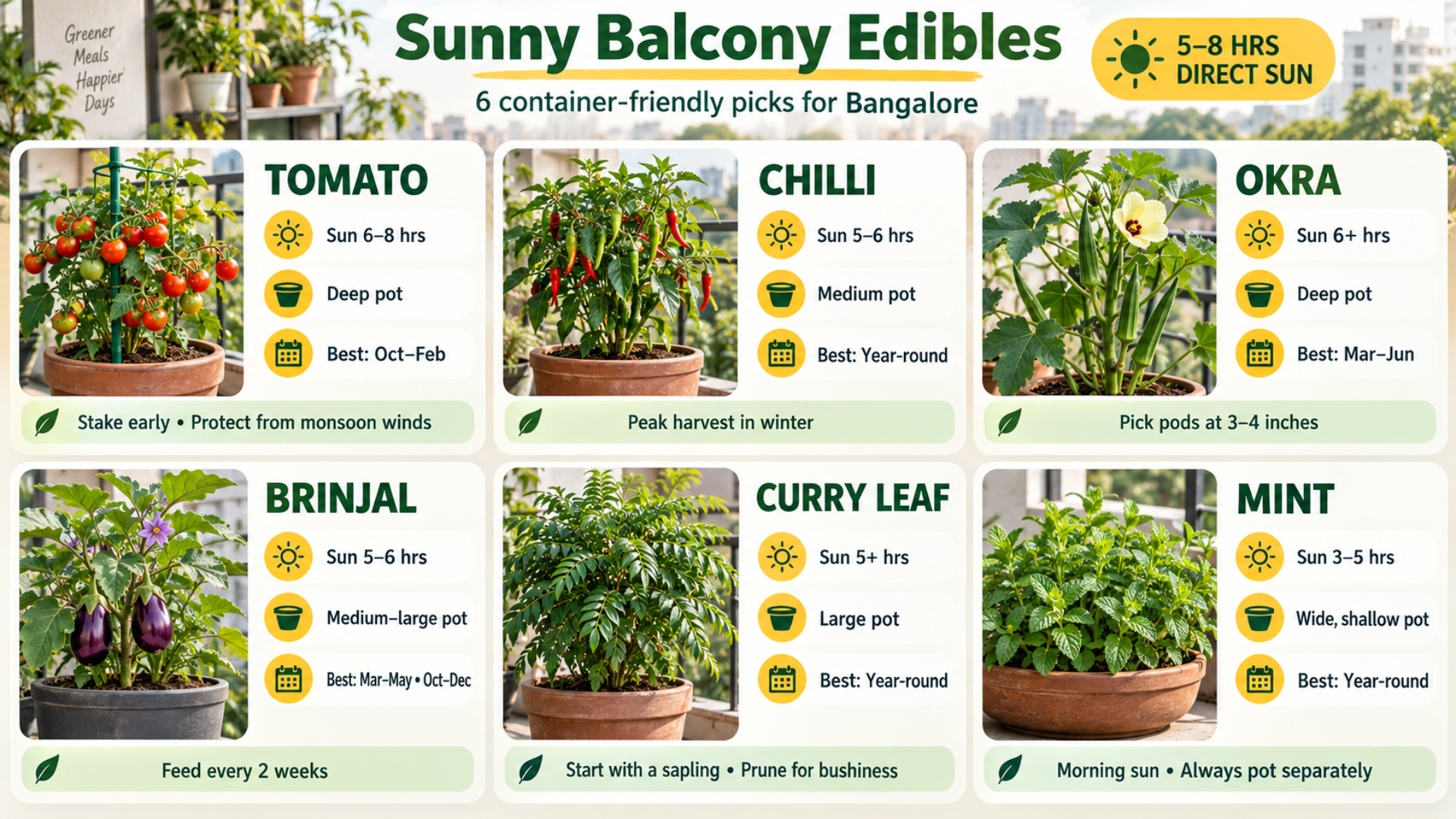
Many vegetables need full sun to produce properly. A Bangalore balcony that gets 5 to 8 hours of direct sunlight can support several container-friendly vegetables, and some of them are difficult to find fresh in stores, which makes growing your own genuinely useful.
Tomato (टमाटर/ಟೊಮೇಟೊ)
The single most popular balcony vegetable in Bangalore, and for good reason. Cherry tomato and desi tomato varieties produce well in containers and keep fruiting for months. Tomatoes can be grown from both tomato plants and seeds, depending on whether you want quicker growth or prefer starting the growing journey from the beginning. Tomatoes need at least 6 hours of direct sun to set fruit properly. Anything less and you get plenty of leaves but very few tomatoes.
- Sunlight: 6 to 8 hours of direct sun for proper fruiting
- Pot size: Choose a deep container as Tomato plants need enough root space to support healthy growth and fruit production
- Bangalore tip: Use a stake or cage from the start. Bangalore's monsoon winds can snap unsupported tomato stems. Pinch off suckers (small shoots growing between the main stem and branches) to direct energy into fruit production
- Best season: October to February gives the best yield. Summer heat above 35°C causes flower drop
Chilli (मिर्च/ಮೆಣಸಿನಕಾಯಿ)
Chilli plants are compact, productive, and perfectly suited to Bangalore's climate year-round. A single healthy plant can produce chillies for 6 to 8 months. You can grow chillies from both chilli plants and seeds, depending on whether you want quicker harvests or prefer growing the plant from the beginning.
- Sunlight: 5 to 6 hours of direct sun
- Pot size: A medium container is suitable for chilli plants and allows enough space for continuous fruiting
- Bangalore tip: The plant often looks bare after monsoon. Do not pull it out. Prune it back by a third, add fresh compost, and it will flush new growth and fruit again in October
- Best season: Produces year-round in Bangalore. Peak harvest is winter
Okra (Bhindi/भिंडी/ಬೆಂಡೇಕಾಯಿ)
Okra is a summer vegetable that genuinely loves heat. It grows fast and produces within 50 to 60 days of sowing. You can grow okra from both seeds and young plants, depending on whether you want to start from the sowing stage or prefer a more established plant.
- Sunlight: 6+ hours of full sun
- Pot size: Use a deep container with enough space for individual plants to develop strong roots
- Bangalore tip: Harvest pods when they are 3 to 4 inches long. Pods left on the plant too long turn woody and the plant slows down
- Best season: March to June. Does not do well in Bangalore's monsoon (too much moisture)
Brinjal (Eggplant/बैंगन/ಬದನೆಕಾಯಿ)
Brinjal handles Bangalore's summer heat well and produces steadily in containers. Choose compact hybrid varieties rather than large desi types for balcony growing. You can grow Brinjal from both seeds and young plants, depending on whether you want to start from the sowing stage or prefer a more established plant.
- Sunlight: 5 to 6 hours of direct sun
- Pot size: Choose a medium to large container as brinjal is a heavy feeder and needs sufficient root space
- Bangalore tip: Brinjal is a heavy feeder. Add organic fertiliser every 2 weeks during the growing season. Watch for fruit and shoot borers, the most common pest on Bangalore balconies
- Best season: March to May and October to December
Curry Leaf Plant (करि पत्ता/मीठा नीम/ಕರಿಬೇವು)
Not technically a vegetable, but no Bangalore kitchen garden is complete without one. Curry leaf plants are tough, aromatic, and thrive in full sun. Over time, a Curry Leaf plant in a large pot grows into a small tree, making it one of the few balcony tree plants that is also genuinely useful.
- Sunlight: 5+ hours of direct sun
- Pot size: Use a large container as Curry Leaf plants gradually develop into a bushy plant or small tree
- Bangalore tip: Start from a sapling, not from seed. Seeds take months to germinate. Prune the top regularly to encourage bushy growth rather than a single tall stem
- Best season: Grows year-round. New leaf flushes are strongest in spring and after monsoon
Mint (पुदीना/ಪುದೀನ)
Mint actually prefers 3 to 4 hours of morning sun and shade during the hot afternoon. On a west-facing Bangalore balcony, place Mint behind a taller plant or in a spot that gets shade after noon.
- Sunlight: 3 to 5 hours, partial to moderate sun. Burns in harsh afternoon light
- Pot size: Use a wide, shallow container as Mint spreads horizontally and can quickly fill available space
- Bangalore tip: Mint is invasive. Always grow it in a separate container, never mixed with other plants. It will take over the pot. Harvest frequently to keep it from getting leggy
- Best season: Grows year-round in Bangalore. Slows down slightly in peak summer
Fruit Plants and Balcony Tree Plants for Sunny Balconies
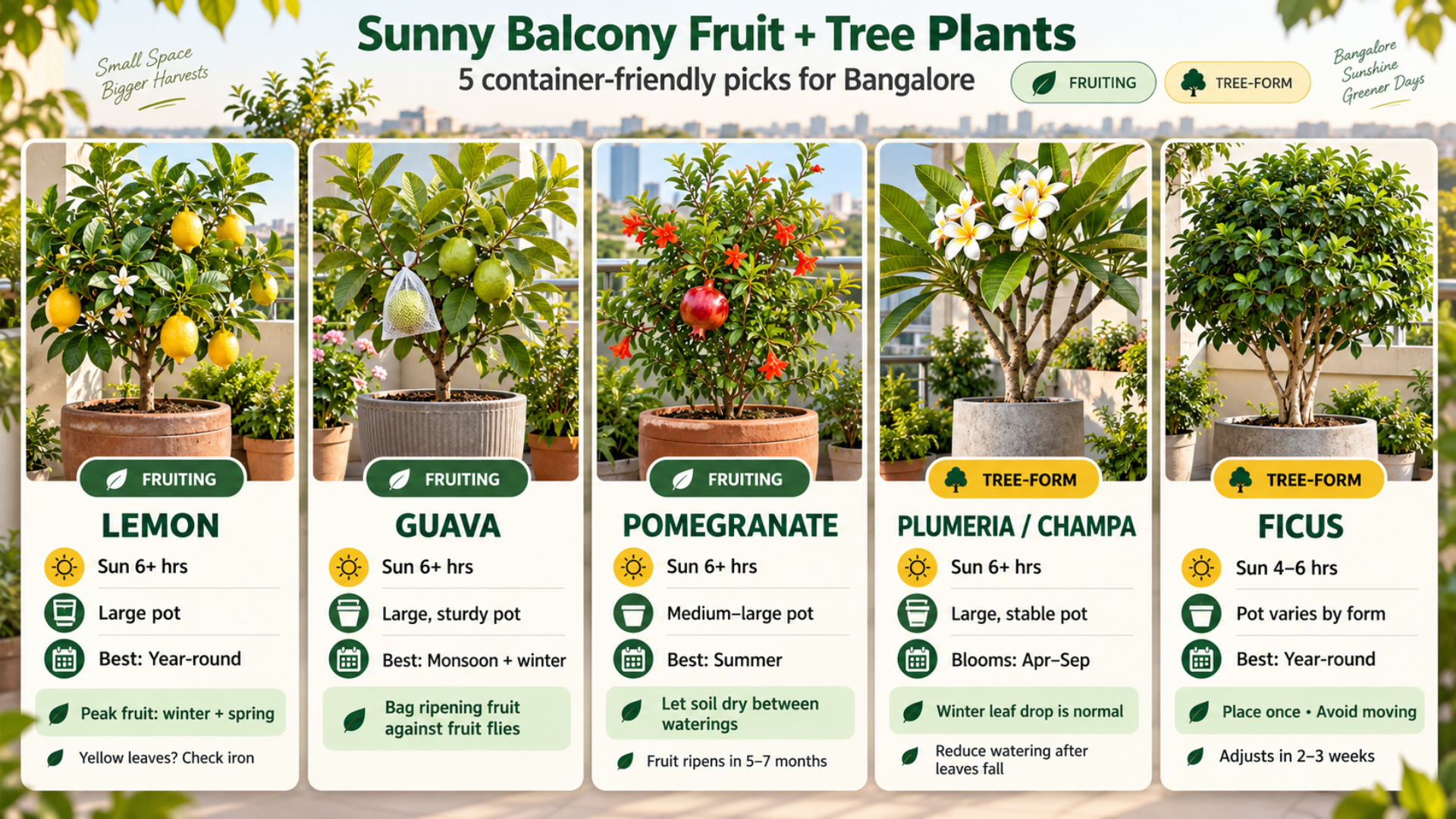
Growing fruit on a balcony takes more patience than flowers or vegetables, but several varieties genuinely produce in Bangalore's climate if they get enough sun. Some of these double as balcony tree plants — they grow tall enough to add greenery at eye level and above, which fills out a terrace garden beautifully.
Lemon (नींबू/ನಿಂಬೆ ಹಣ್ಣು)
The most practical fruiting plant for a Bangalore balcony. A well-maintained Lemon plant in a sunny spot will produce fruit within a year of planting. It also grows into a small tree shape over time, making it a solid option if you want height on your balcony.
- Sunlight: 6+ hours of direct sun. More sun means more fruit
- Pot size: Use a large container with enough room for root development and long-term growth
- Bangalore tip: Yellow leaves usually mean the plant needs iron, not more water. Add a small amount of ferrous sulphate to the soil every few months
- Best season: Fruits year-round once established. Heaviest production in winter and spring
Guava (Amrood / अमरूद / ಸೀಬೆಹಣ್ಣು)
Guava is a rewarding fruit plant for sunny balconies and terraces. It grows well in large containers with proper care and can provide fresh, homegrown fruits over time. With regular pruning, a Guava plant can be maintained at a manageable size while adding a tree-like structure to your balcony garden.
- Sunlight: 6+ hours of direct sun
- Pot size: Choose a large, sturdy container because Guava plants become heavier as they grow and start producing fruit
- Bangalore tip: Guava attracts fruit flies in Bangalore. Bag individual fruits with net covers when they start to ripen
- Best season: Fruits mainly during monsoon and winter
Pomegranate (Anaar / अनार / ದಾಳಿಂಬೆ)
Pomegranate is one of the most sun-tolerant fruit plants you can grow on a balcony. Pomegranate plants actually perform better in dry, sunny conditions than in humid, shaded ones.
- Sunlight: 6+ hours direct sun
- Pot size: Use a medium to large container with good drainage to support healthy root growth
- Bangalore tip: Let the soil dry out between waterings. Pomegranate roots are prone to rot in consistently wet soil, especially during Bangalore's monsoon months
- Best season: Flowers and fruits in summer. Fruit takes 5 to 7 months to ripen
Plumeria / Champa (चंपा/ಸಂಪಿಗೆ ಹೂವು)
Plumeria is a tropical flowering tree that produces intensely fragrant white, yellow, or pink flowers. Plumeria plants handle direct sun and heat well and grow to 3 to 5 feet in a large pot, one of the best large plants for a sunny balcony or terrace.
- Sunlight: 6+ hours of full sun
- Pot size: Choose a large, stable planter as Plumeria grows into a taller plant and can become top-heavy
- Bangalore tip: Plumeria drops its leaves in winter. This is normal — the plant is deciduous. Do not increase watering when leaves fall. Reduce it. New growth returns in spring
- Best season: Flowers heavily from April to September
Ficus (फाइकस/ಫಿಕಸ್)
If you want a true tree form on your balcony without the tree-sized pot, a Ficus works well. It tolerates direct sun, stays compact with pruning, and gives a dense canopy of green leaves.
- Sunlight: 4 to 6 hours of direct sun
- Pot size: The container size depends on the variety and form. Bonsai types need smaller containers, while larger Ficus plants require more root space
- Bangalore tip: Ficus drops leaves when moved from one light condition to another. Place it once and leave it. It adjusts in 2 to 3 weeks
- Best season: Evergreen. Grows steadily year-round in Bangalore
Which Low-Maintenance Plants to Consider for Sunny Balconies?
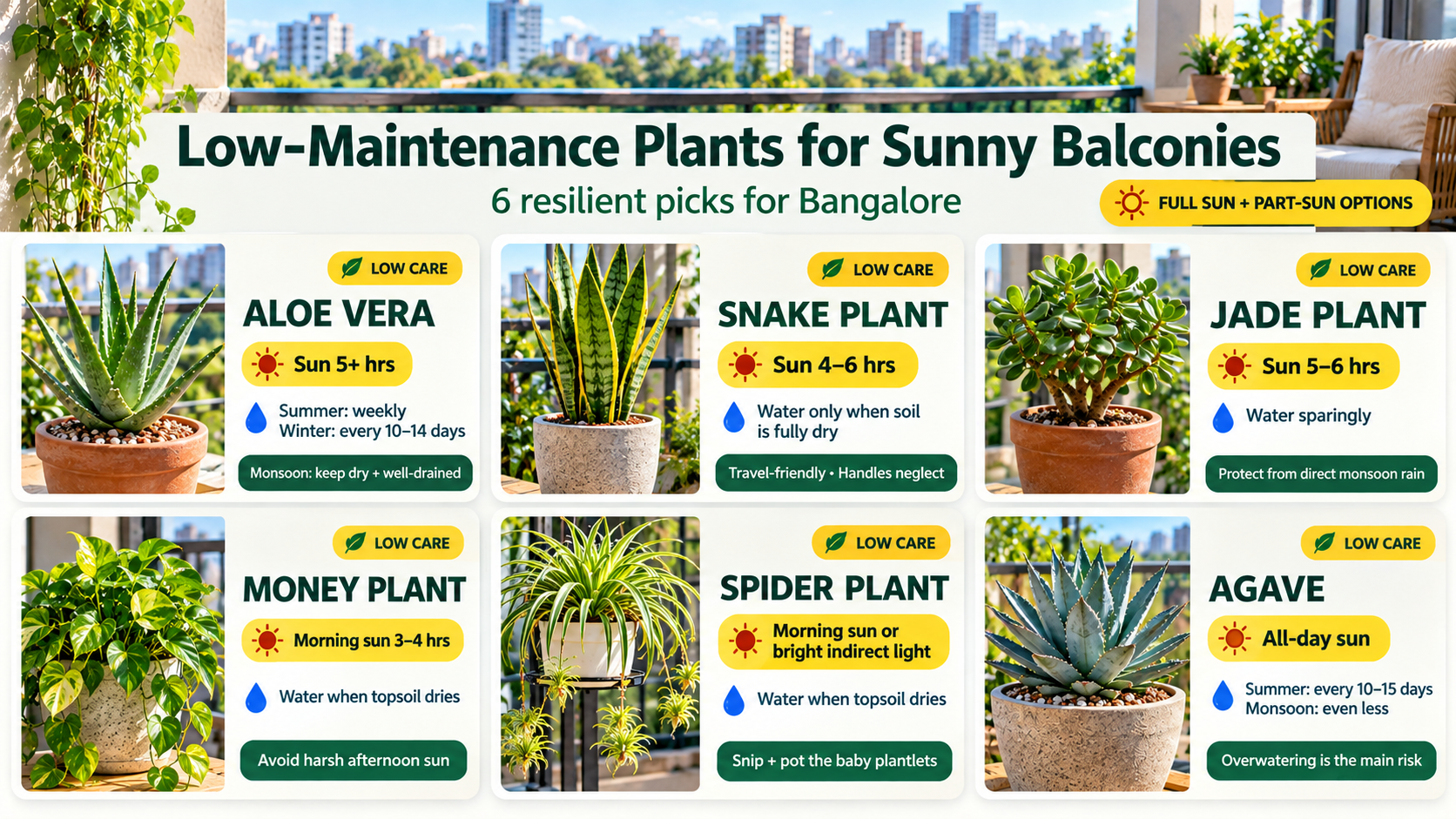
Not every balcony gardener wants to spend time every day on care and watering. If you want potted plants that handle full sun and heat with minimal effort, these are the safest picks.
Aloe Vera (घृतकुमारी / ग्वारपाठा/ಅಲೋವೆರಾ)
Aloe Vera does best with 5+ hours of direct sun. It is a true succulent that stores water in its thick leaves and tolerates long dry stretches. Water once a week in summer, once every 10 to 14 days in winter. The most common mistake with Aloe Vera in Bangalore is overwatering during monsoon, which causes root rot within days. Use a pot with excellent drainage and a gritty, fast-draining soil mix.
Snake Plant (स्नेक प्लांट/ಸ್ನೇಕ್ ಪ್ಲಾಂಟ್)
Snake Plant tolerates 4 to 6 hours of direct sun and survives weeks of neglect. In Bangalore, Snake plants grow faster on a sunny balcony than indoors, and the leaves develop stronger variegation with more light exposure. Water only when the soil is completely dry. This is one of the best low-maintenance balcony plants for people who travel frequently or forget to water.
Jade Plant (जेड प्लांट/ಜೇಡ್ ಪ್ಲಾಂಟ್)
Thrives in 5 to 6 hours of direct sun. A true succulent that stores water in its thick leaves, so it handles Bangalore's dry summer weeks without trouble. Keep it out of direct rain during monsoon because waterlogged soil kills Jade plants quickly.
Money Plant (मनी प्लांट/ಮನಿ ಪ್ಲಾಂಟ್)
Money Plant is usually grown in shade, but it handles 3 to 4 hours of direct morning sun on a Bangalore balcony without burning. Avoid harsh afternoon sun. The leaves of Money plant grow larger and develop a deeper green colour with some direct light compared to pure shade.
Spider Plant (मकड़ी पौधा/ಸ್ಪೈಡರ್ ಪ್ಲಾಂಟ್)
Spider Plant adapts to both direct morning sun and bright indirect light. It produces baby plantlets on runners, which you can snip off and pot separately to grow your collection. Spider plant requires watering only when the topsoil dries out. Good for apartment balconies where direct sun comes in for only part of the day.
Agave (अगावे/ಅಗಾ)
If your balcony gets all-day sun and you want something architectural that needs almost zero care, Agave is hard to beat. It tolerates extreme heat, drought, and poor soil. Water it once every 10 to 15 days in summer and even less in monsoon. The only thing that kills it is overwatering.
Season-Wise Planting Calendar for Bangalore Balconies
Summer (March to May)
- Plant these: Bougainvillea, Portulaca, Vinca, Hibiscus, Lantana, Gaillardia, Zinnia, Marigold, Tomato, Chilli, Okra, Brinjal, Curry Leaves, Lemon, Aloe Vera.
- Watch out for: Rapid soil drying in small pots, leaf scorch on newly placed plants, spider mites (they thrive in hot, dry conditions).
- Key action: Water early in the morning, never in the afternoon when the pot and soil are hot. How many hours of sunlight do plants need in summer? Most sun-loving plants are fine with 6 to 8 hours, but even heat-tolerant varieties benefit from afternoon shade when temperatures cross 35°C.
Monsoon (June to September)
- Plant these: Hibiscus, Jasmine, Ixora, Impatiens, Lantana, Spinach, Coriander, Fenugreek, Beans, Cucumber.
- Watch out for: Root rot from waterlogged soil, fungal diseases on leaves, mealybugs and aphids that breed faster in humid air.
- Key action: Check drainage holes on every pot. Move sensitive plants under a covered section if your balcony gets direct rain. Reduce watering frequency because the soil retains moisture much longer.
Winter (November to February)
- Plant these: Petunia, Chrysanthemum, Dahlia, Calendula, Pansy, Gaillardia, Tomato, Carrot, Peas, Beetroot, Cauliflower, Strawberry.
- Watch out for: Very few pests or weather problems in Bangalore's winter. This is the safest season to try new plants.
- Key action: This is the best time to repot, add fresh soil, and start seeds. Most plants grow fastest during Bangalore's winter months. If you are starting a balcony garden for the first time, November is the ideal month to begin.
How to Protect Balcony Plants From Strong Sunlight
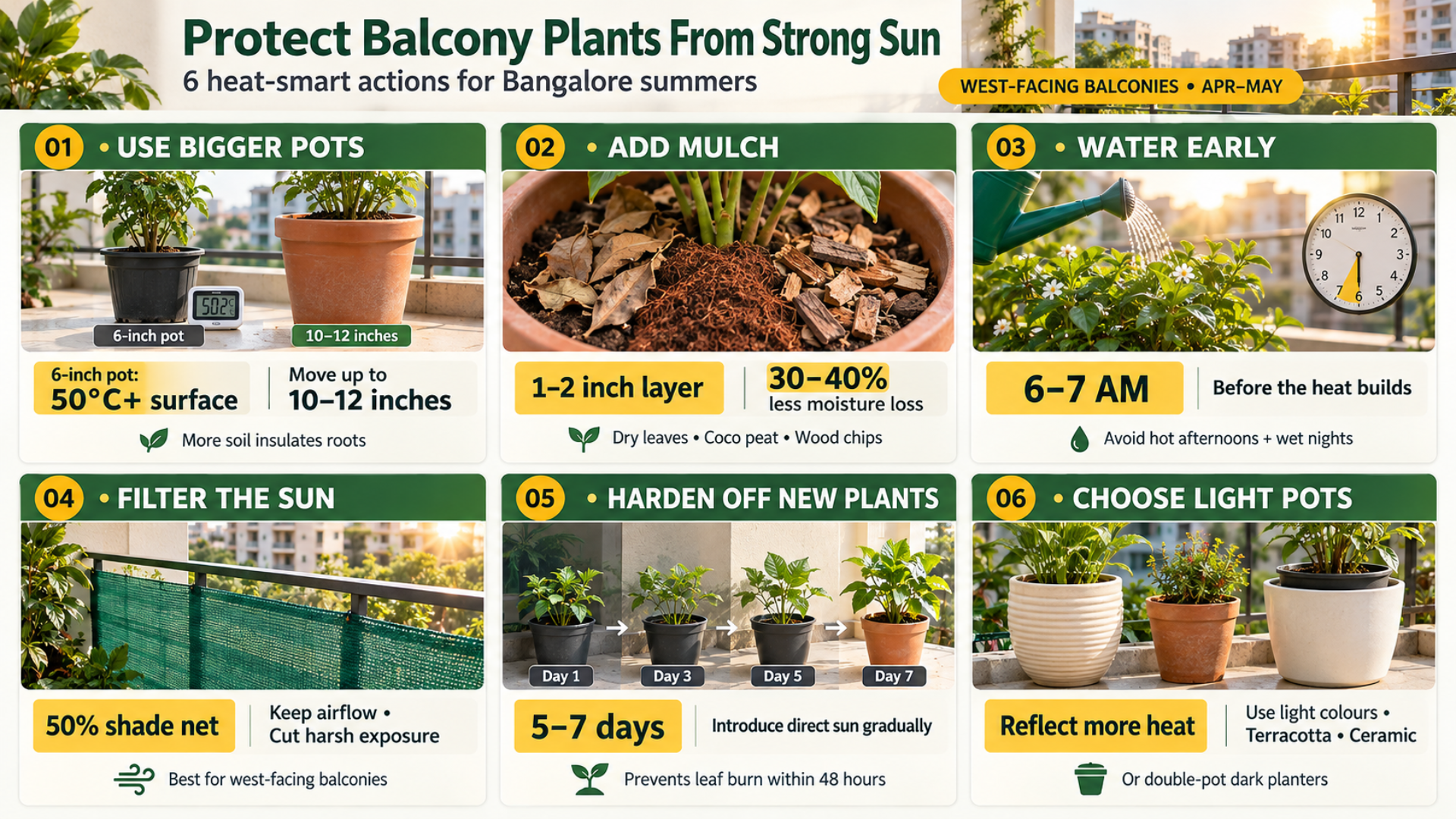
Even the toughest sun-loving plants can struggle during Bangalore's peak summer weeks, especially on west-facing balconies. Here is what actually works to protect plants from sunburn and heat damage.
1. Use Bigger Pots
A 6-inch pot sitting in direct afternoon sun can heat up to 50°C+ at the surface. The roots cook before the leaves even show signs of stress. Moving to a 10 or 12-inch pot gives roots more insulated soil to work with.
2. Add a Mulch Layer
A 1 to 2 inch layer of mulch (dry leaves, coco peat, or wood chips) on top of the soil reduces surface temperature and slows down moisture loss by 30 to 40%. This is the single easiest thing you can do to protect plants from sun damage.
3. Water Early Morning
Watering at 6 to 7 AM gives plants time to absorb moisture before the heat sets in. Watering in the afternoon, when the pot is hot, can shock roots. Watering at night keeps the soil wet for too long and invites fungal problems.
4. Filter Sunlight for Sensitive Plants
If some of your plants are getting too much direct sun, use a 50% green shade net hung on the outer railing. This filters sunlight without blocking airflow. It is especially useful for west-facing Bangalore balconies during April and May. Shade nets are cheap, widely available at local nurseries, and can be rolled up when the intense heat passes.
5. Avoid Sudden Full Sun Exposure
A plant bought from a nursery has been growing under shade nets. Placing it directly in full sun on day one will burn the leaves within 48 hours. Keep new plants in a partially shaded spot for 5 to 7 days and gradually move them into direct sun. This is called hardening off, and it prevents sunburn on new plants.
6. Use Light-Coloured Pots
Black and dark-coloured pots absorb more heat and can damage roots faster. On sunny balconies, use light-coloured, terracotta, or ceramic planters, or place dark pots inside a slightly larger light-coloured outer pot to insulate them.
Common Mistakes With Outdoor Balcony Plants in Direct Sun
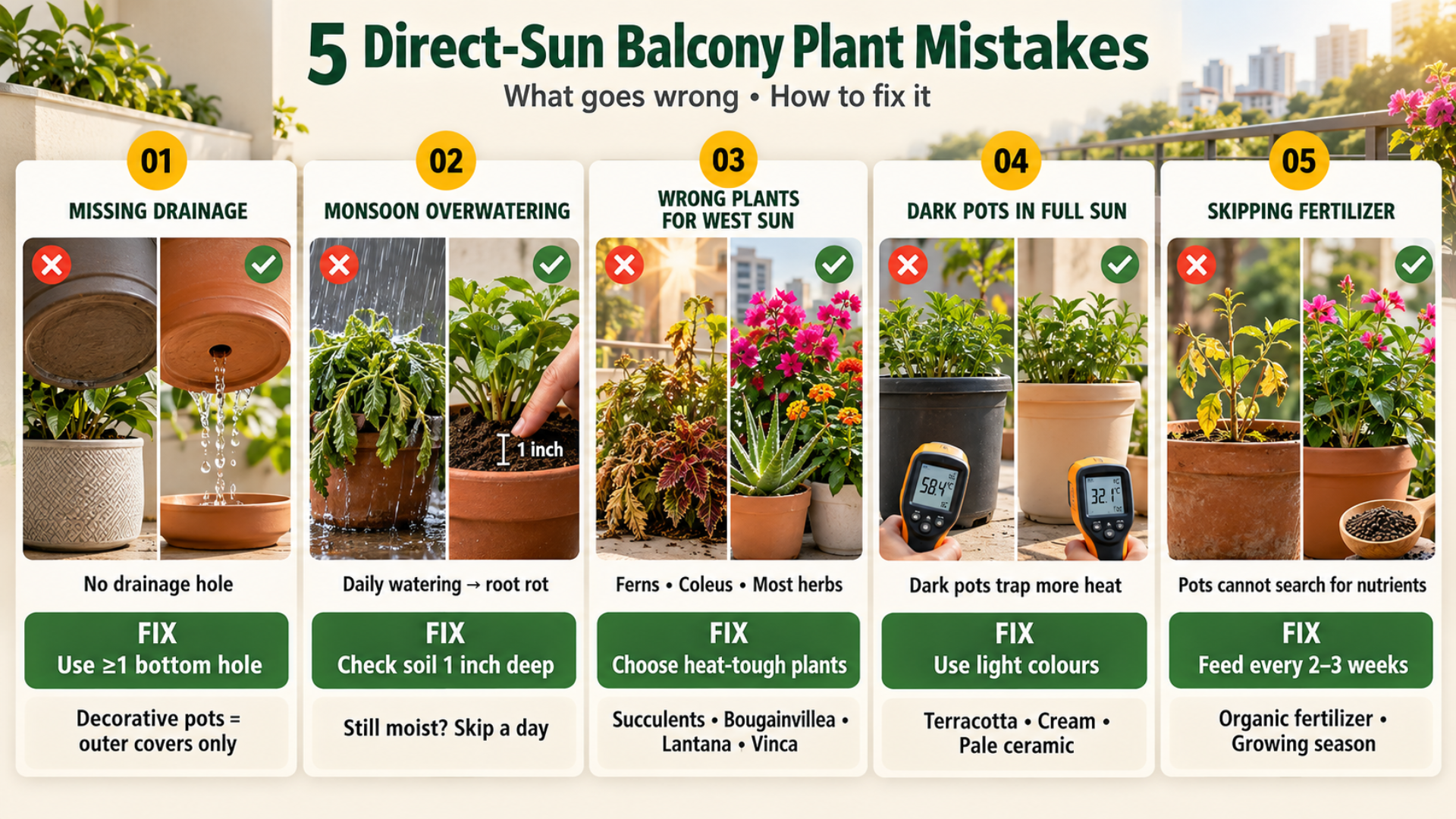
1. Using Pots Without Drainage Holes
This is the number one killer of balcony plants in Bangalore, especially during monsoon. Every pot needs at least one drainage hole at the bottom. Decorative planters without holes should only be used as outer covers, not as the actual planting pot.
2. Overwatering During Monsoon
The instinct to water every day works in summer but causes root rot in monsoon. Check the soil before watering. If it feels moist an inch below the surface, skip watering for another day.
3. Choosing Thin-Leaved Plants for a West-Facing Balcony
Ferns, coleus, and most herbs cannot handle the afternoon sun on a west-facing Bangalore balcony in summer. Stick with thick-leaved succulents, Bougainvillea, Lantana, or Vinca for these spots.
4. Ignoring Pot Colour
Dark pots absorb more heat and can cook roots on a sunny balcony. Switch to light-coloured or terracotta planters.
5. Skipping Fertilizer Entirely
Balcony plants depend entirely on the soil in their pot. Unlike garden plants, they cannot spread roots to find nutrients. Feed flowering and vegetable plants every 2 to 3 weeks during the growing season with an organic fertilizer.
6. Planting Everything in the Same Size Pot
A Bougainvillea needs 12+ inches. A Vinca does fine in 6 inches. A Tomato needs depth. Using the same pot for everything means some plants are cramped and others have too much wet soil around their roots.
Creating a Sunny Bangalore Balcony Garden
A successful balcony garden starts with choosing plants that match your space, not simply selecting the most attractive varieties. Before buying plants, check:
- How many hours of direct sunlight your balcony receives
- Whether it faces east, west, north, or south
- How much time you can spend on maintenance
For beginners, start with easy plants like:
- Aloe Vera
- Vinca
- Portulaca
- Chilli
- Bougainvillea
Once these plants establish well, you can gradually expand your balcony garden with vegetables, fruit plants, and larger flowering varieties. The right plant in the right location will make your Bangalore balcony greener, healthier, and easier to maintain.
Frequently Asked Questions (FAQs)
1. Which plants can survive direct sunlight in Bangalore?
Bougainvillea, Hibiscus, Vinca, Portulaca, Lantana, Gaillardia, Aloe Vera, Snake Plant, Jade Plant, Curry Leaf, and Lemon all handle direct sunlight well on a Bangalore balcony. The key is matching the plant to the hours of sun and the direction your balcony faces. West-facing balconies need the toughest varieties like Portulaca, Lantana, and Aloe Vera, while south-facing balconies with steady but less intense sun support a wider range including Hibiscus and Marigold.
2. What are the best sun-loving plants for balconies?
For flowering, Bougainvillea and Vinca are the most dependable because they bloom heavily in strong sun and tolerate heat. For low-maintenance greenery, Aloe Vera and Snake Plant work well. For a productive balcony, Tomato, Chilli, and Lemon give you something you can actually use in the kitchen. For a large visual impact, Lantana and Gaillardia flower for months with minimal care.
3. What are some good flowering plants for a balcony in Bangalore?
Bougainvillea, Hibiscus, Vinca (Sadabahar), Portulaca, Marigold, Lantana, Gaillardia, and Zinnia all flower reliably on Bangalore balconies. If your balcony gets 6+ hours of sun, all of these will bloom well. If it gets 4 to 5 hours, stick with Hibiscus, Marigold, and Zinnia, which perform better in moderate sun.
4. Which vegetables can grow in full sunlight?
Tomato, Chilli, Okra, Brinjal, and Curry Leaves all need full sun and grow well in containers on a Bangalore balcony. Tomato and Chilli are the easiest to start with because they produce quickly and tolerate minor care mistakes. For herbs, Curry Leaf handles full sun well, while Mint prefers partial sun with some afternoon shade.
5. What potted plants are good for full sun and heat?
Portulaca, Vinca, Aloe Vera, Jade Plant, Agave, and Lantana are the most heat-tolerant potted plants for Bangalore balconies. All of these survive 35°C+ temperatures, infrequent watering, and strong afternoon sun without needing daily attention.
6. Which balcony plants need the least maintenance?
Snake Plant, Aloe Vera, Jade Plant, and Agave are the lowest maintenance options. All four are succulents or near-succulents that store water, tolerate missed watering sessions, and do not need regular fertilizing. Among flowering plants, Vinca and Lantana are the closest to "plant it and forget it" because both flower with minimal care and bounce back from neglect.
7. Can large plants grow on a balcony with full sun?
Yes. Bougainvillea, Oleander, Plumeria (Champa), Curry Leaf tree, Dwarf Guava, and Lemon all grow to 3 to 5+ feet in large pots and do well on sunny balconies or terrace gardens. Use heavy, stable planters (14 to 18 inches) so they do not tip over in wind.
8. How do I protect plants from sunburn?
Use bigger pots (10 inches or above), add a mulch layer over the soil, water early in the morning, use light-coloured or terracotta planters, and introduce new plants to direct sun gradually over 5 to 7 days. For west-facing balconies, a 50% shade net hung on the railing in April and May prevents the worst afternoon damage.
9. Do succulents need direct sunlight?
Most succulents do well with 4 to 6 hours of direct sunlight. Aloe Vera, Jade Plant, and Agave actively prefer direct sun and grow better with more light. However, not all succulents tolerate all-day harsh summer sun; some softer succulents like Echeveria can scorch in Bangalore's afternoon heat. Place these in a spot that gets morning sun and afternoon shade.
10. What is the best season to start a balcony garden in Bangalore?
Winter (November to February) is the best season to start. Temperatures are mild, pests are less active, and most plants establish themselves quickly. If you start in summer, stick to heat-tolerant picks like Bougainvillea, Chilli, Vinca, and Aloe Vera. Avoid starting a new garden during monsoon — the high humidity and constant soil moisture make it harder for new plants to settle in.
11. Does Mint plant need direct sunlight?
Mint does not need full direct sunlight. It grows best with 3 to 4 hours of morning sun and shade during the hot afternoon. On a sunny Bangalore balcony, place mint behind taller plants or in a spot that gets filtered light after noon. Too much direct sun causes the leaves to become small and the plant to dry out quickly.
12. How much sunlight do plants need per day?
It depends on the plant type. Full sun plants like Bougainvillea, Portulaca, and Tomato need 6 to 8 hours of direct sunlight. Moderate sun plants like Hibiscus, Marigold, and Chilli do well with 4 to 6 hours. Herbs like Mint and Coriander prefer 3 to 4 hours of gentle morning sun. Check individual plant requirements before placing them on your balcony.
13. ಸಸ್ಯಗಳಿಗೆ ನೇರ ಸೂರ್ಯನ ಬೆಳಕು ಬೇಕೇ ಅಥವಾ ಕೇವಲ ಪ್ರಕಾಶಮಾನವಾದ ಬೆಳಕು ಸಾಕೇ?
ಹೆಚ್ಚಿನ ಹೂ ಬಿಡುವ ಮತ್ತು ಹಣ್ಣು ನೀಡುವ ಸಸ್ಯಗಳಿಗೆ ನೇರ ಸೂರ್ಯನ ಬೆಳಕು ಅಗತ್ಯವಿರುತ್ತದೆ. ಅಂದರೆ, ಸೂರ್ಯನ ಕಿರಣಗಳು ನೇರವಾಗಿ ಎಲೆಗಳ ಮೇಲೆ ಬೀಳಬೇಕು, ಆಗ ಮಾತ್ರ ಅವು ಉತ್ತಮವಾಗಿ ಹೂ ಬಿಡಲು ಮತ್ತು ಉತ್ಪಾದನೆ ಮಾಡಲು ಸಾಧ್ಯವಾಗುತ್ತದೆ. ಪ್ರಕಾಶಮಾನವಾದ ಪರೋಕ್ಷ ಬೆಳಕು (ಗೋಡೆಗಳಿಂದ ಪ್ರತಿಫಲಿಸುವ ಅಥವಾ ಫಿಲ್ಟರ್ ಆಗಿ ಬರುವ ಬೆಳಕು) ನೇರ ಸೂರ್ಯನ ಬೆಳಕಿಗೆ ಸಮಾನವಲ್ಲ ಮತ್ತು ಬೋಗನ್ವಿಲಿಯಾ ಅಥವಾ ಟೊಮೇಟೊಗಳಂತಹ ನೇರ ಬಿಸಿಲನ್ನು ಇಷ್ಟಪಡುವ ಸಸ್ಯಗಳಲ್ಲಿ ಹೂ ಬಿಡುವಿಕೆಯನ್ನು ಉತ್ತೇಜಿಸುವುದಿಲ್ಲ. ಮತ್ತೊಂದೆಡೆ, ಸ್ನೇಕ್ ಪ್ಲಾಂಟ್ ಮತ್ತು ಮನಿ ಪ್ಲಾಂಟ್ನಂತಹ ಎಲೆಗಳ ಸಸ್ಯಗಳು ನೇರ ಸೂರ್ಯನ ಬೆಳಕಿನ ಅಗತ್ಯವಿಲ್ಲದೆ ಪ್ರಕಾಶಮಾನವಾದ ಪರೋಕ್ಷ ಬೆಳಕಿನಲ್ಲಿ ಉತ್ತಮವಾಗಿ ಬೆಳೆಯುತ್ತವೆ.
14. ನಿಮ್ಮ ಬೆಂಗಳೂರು ಬಾಲ್ಕನಿಗೆ ಸರಿಯಾದ ಸಸ್ಯವನ್ನು ಹೇಗೆ ಆಯ್ಕೆ ಮಾಡುವುದು?
ಸಸ್ಯಗಳನ್ನು ಖರೀದಿಸುವ ಮೊದಲು, ನಿಮ್ಮ ಬಾಲ್ಕನಿಯಲ್ಲಿ ಲಭ್ಯವಿರುವ ಸೂರ್ಯನ ಬೆಳಕು, ಸ್ಥಳಾವಕಾಶ ಮತ್ತು ನಿರ್ವಹಣೆಯ ಅಗತ್ಯಗಳನ್ನು ಪರಿಶೀಲಿಸಿ. ಹೆಚ್ಚು ಬೆಳಕು ಇರುವ ಪ್ರದೇಶಗಳಿಗೆ ಸೂರ್ಯನ ಬೆಳಕನ್ನು ಇಷ್ಟಪಡುವ ಸಸ್ಯಗಳನ್ನು, ಸಣ್ಣ ಬಾಲ್ಕನಿಗಳಿಗೆ ಕಡಿಮೆ ಸ್ಥಳ ತೆಗೆದುಕೊಳ್ಳುವ ಸಸ್ಯಗಳನ್ನು ಮತ್ತು ಕಡಿಮೆ ಸಮಯವಿದ್ದರೆ ಸುಲಭವಾಗಿ ನಿರ್ವಹಿಸಬಹುದಾದ ಸಸ್ಯಗಳನ್ನು ಆಯ್ಕೆ ಮಾಡಿ.