


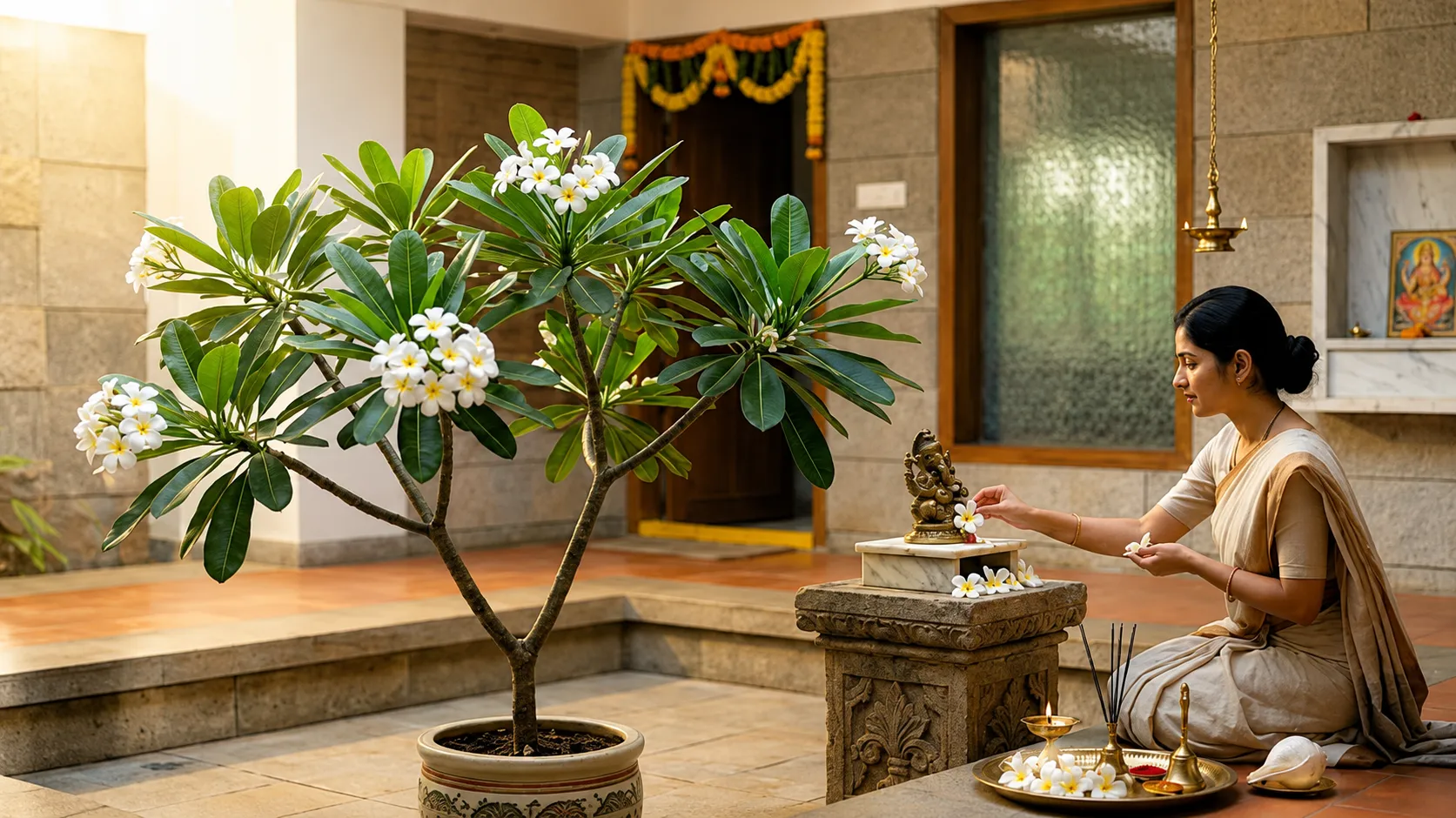
Find out why Champa holds sacred importance in India, its connection to worship, Shiva puja, temple traditions, symbolism, and home gardening.
Key Takeaways
- Plumeria, known in India as Champa (चंपा), is deeply connected to Indian worship, spirituality, and temple traditions.
- Revered in Hinduism, Buddhism, and Jainism, Champa is considered a symbol of purity, devotion, and spiritual awakening.
- Champa flowers are strongly associated with Lord Shiva and are commonly used in Shiv puja rituals across India.
- The five petals of Plumeria represent the Pancha Bhuta — the five elements of existence: Earth (Prithvi), Water (Ap or Jal), Fire (Agni or Tejas), Air (Vayu), and Space (Akasha or Ether).
- Plumeria is commonly planted near temples and sacred spaces because of its soothing fragrance and auspicious presence.
- The plant blooms beautifully during major Indian festival seasons, typically from April to October.
- Champa grows well in Indian homes when provided with full sunlight, well-draining soil, and controlled watering.
- For centuries, Champa has remained both a sacred flower in worship and a beloved ornamental plant in Indian home gardens.
Close your eyes and picture a temple at dusk. Incense in the air. A brass diya is flickering. And somewhere nearby, the unmistakable fragrance of Champa drifted through the evening.
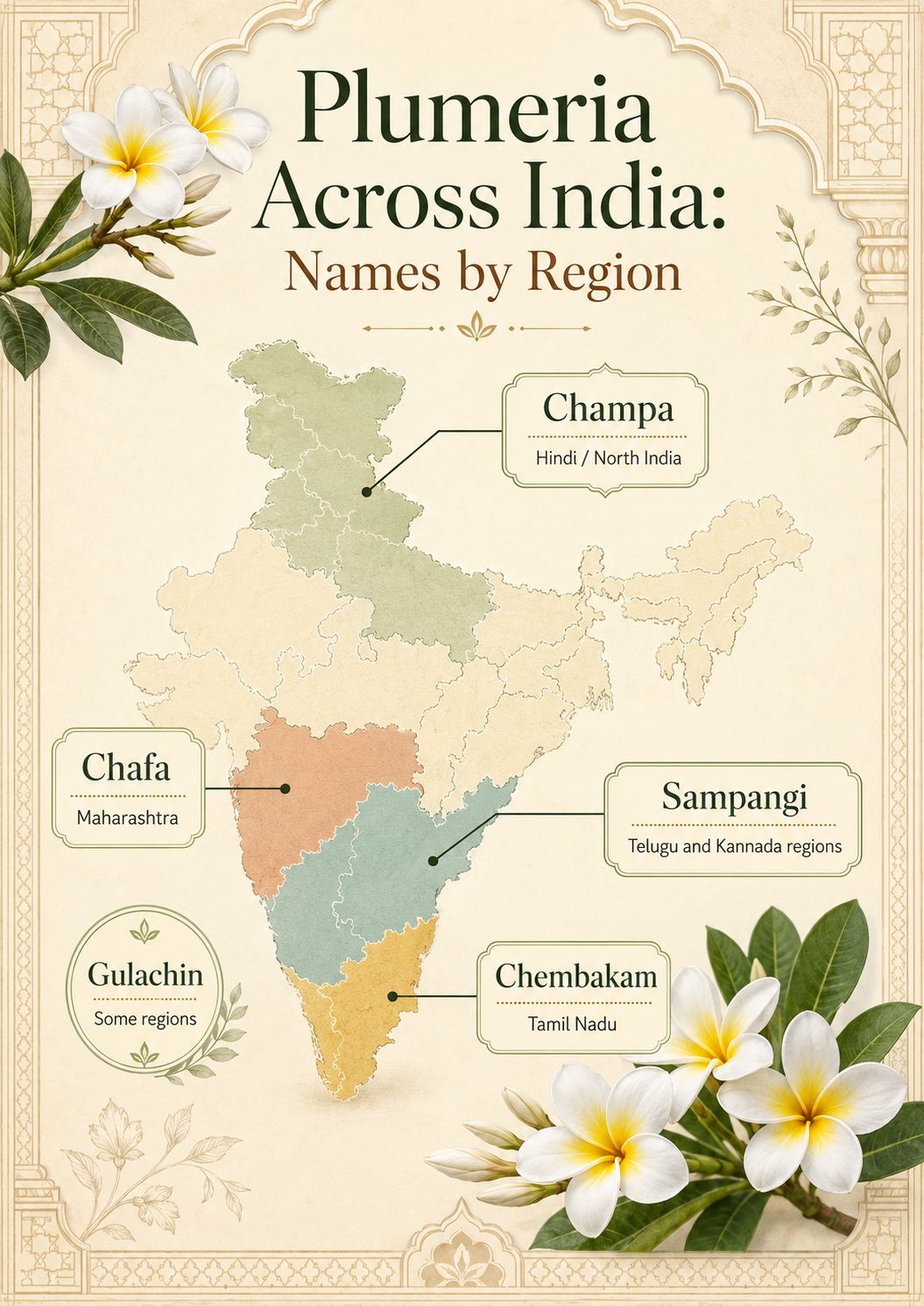
That scent is Plumeria, known internationally as Frangipani, but known to us by names we grew up with, such as:
- Champa in Hindi
- Sampangi in Telugu and Kannada
- Chafa in Marathi
- Chembakam in Tamil
- Gulachin in some parts of the country
Every region has its own name for this flower, because every region has its own history with it.
This is not just a pretty garden plant. In India, Plumeria has been woven into worship, ritual, and daily life for centuries. Here is the story behind the fragrance.
What Is the Plumeria Plant? (And Why Indians Know It by a Different Name)
Plumeria is the botanical name. Frangipani is what the rest of the world calls it. But in India, we never needed either name, because we had Champa.
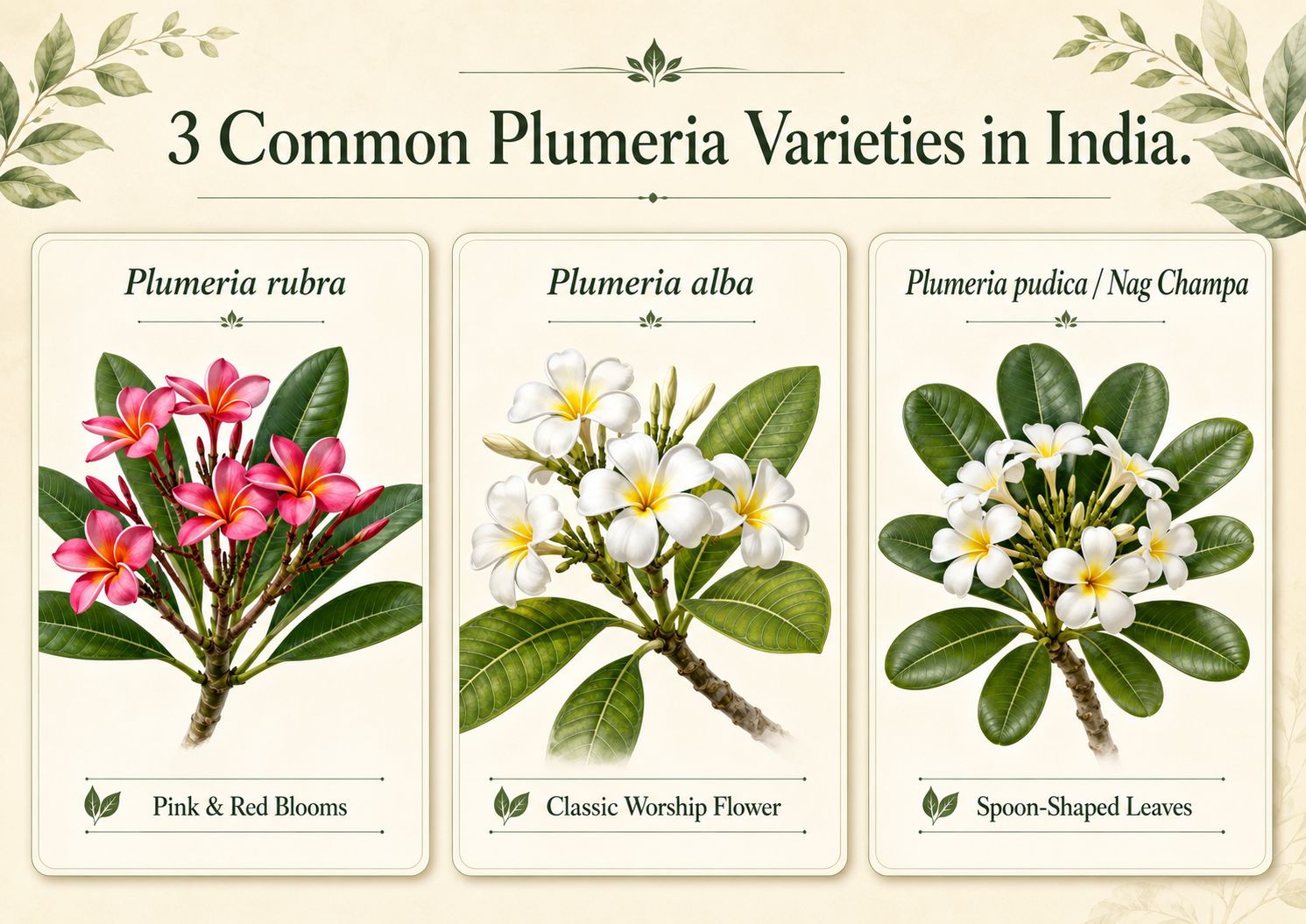
- The plant belongs to the Apocynaceae family and comes in several varieties.
- Plumeria rubra produces the familiar pink and red flowers seen across Indian gardens.
- Plumeria alba bears the classic white bloom used most widely in worship.
- Plumeria pudica, known as Nag Champa in many parts of India, has distinctive spoon-shaped leaves and clusters of white flowers with yellow centers.
All three grow well across India. They are native to tropical America, including Central America, Mexico, and the Caribbean, but have found a second home in the Indian subcontinent so completely that most people assume this flower has always been ours.
Three Major Indian Religions Revere the Plumeria Plant
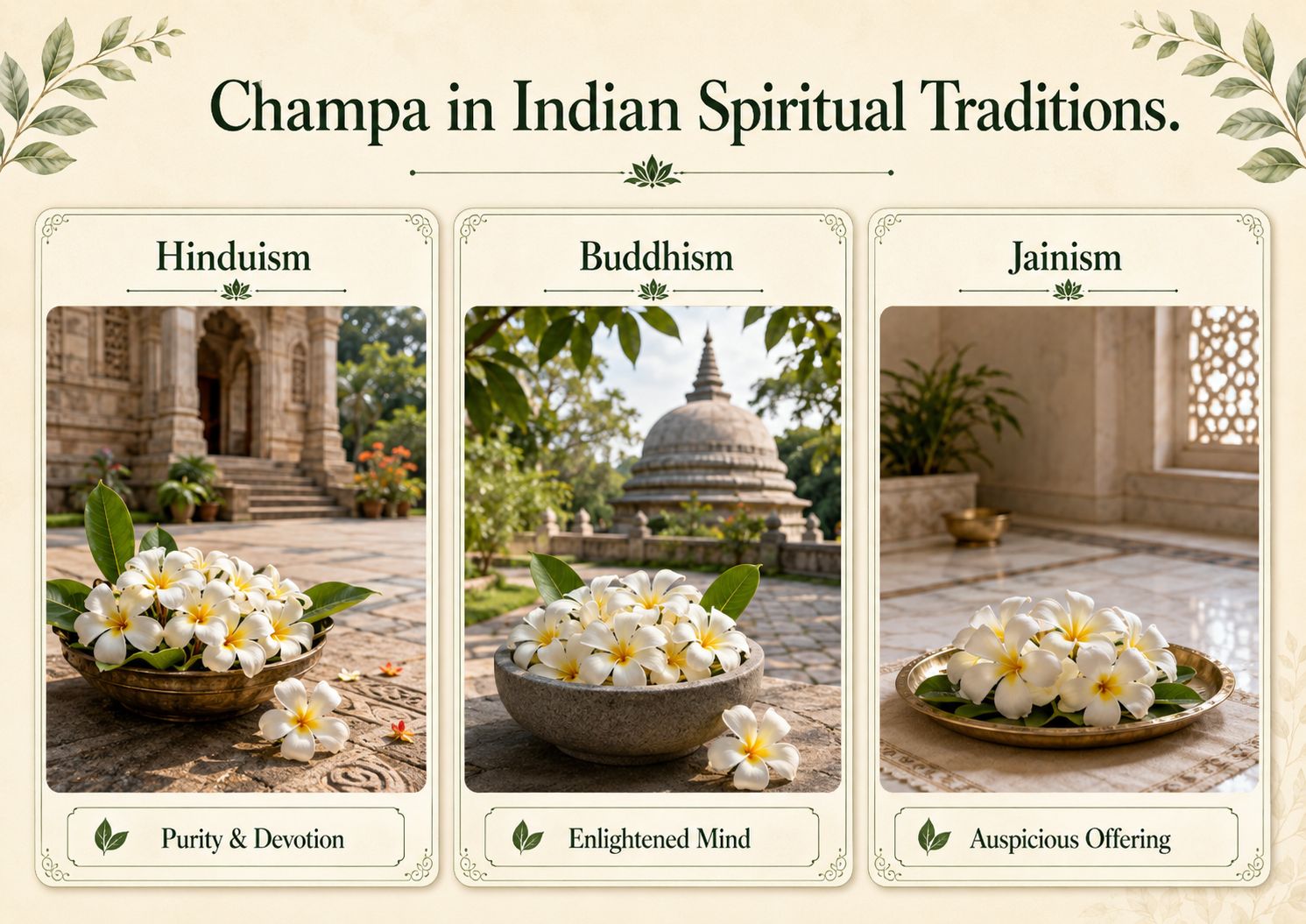
No other flowering plant occupies quite the same space in Indian devotional life as Champa. Its presence in temples, rituals, and religious art across three major religions is no coincidence. It is an intention.
In Hinduism
The Champa flower is offered to deities as a symbol of purity and devotion. Its fragrance is considered sacred, believed to elevate the atmosphere of worship and attract divine presence. You will find it in garlands placed on idols, scattered at the feet of deities, and used during abhishekam rituals.
The tree itself is planted in temple courtyards across India, from the grand temples of Tamil Nadu to neighbourhood mandirs in North India. Its flowers fall continuously during the blooming season, ready for offering without being plucked. This quality alone gives it a special place in Hindu worship. The earth gives the offering, so no harm is done to the plant.
In Buddhism
Depictions of the Frangipani flower in Buddhist art and temple architecture across Southeast Asia date back to the 9th century. The flower is associated with immortality and is often found surrounding Buddhist shrines and stupas. In many Buddhist traditions, its white blooms represent the purity of the enlightened mind.
In Jainism
The Champa flower is considered auspicious in Jain worship and is used during prayer rituals and offerings. Its purity, both visual and aromatic, aligns with the Jain values of non-violence and spiritual cleanliness.
Across all three traditions, the message is the same. This flower represents something that transcends the ordinary. That is why it has remained in Indian devotional life for as long as we can trace.
Plumeria Is the Preferred Flower for Shiva Worship

Of all the deities in the Hindu tradition, Lord Shiva has one of the most specific relationships with Champa, and the reason goes beyond simple preference.
The white Plumeria alba is most commonly used in Shiv puja. Its white colour represents purity. Its fragrance represents devotion. Both are qualities central to the worship of Lord Shiva. The flower is used in abhishekam, placed on the Shivling, and woven into garlands for ritual use.
There is also a deeper logic. Shiva worship emphasises the offering of things that are natural, unprocessed, and given without attachment. A Champa flower that has fallen from the tree on its own, offered directly to the deity without being cut, embodies exactly that quality. Nothing was taken. Everything was given freely.
One thing worth knowing: some regional temple traditions have specific preferences about which flowers are used in puja. Local customs vary, and it is always right to follow the practice of your temple or tradition. But across most of India, offering Champa to Lord Shiva is considered entirely appropriate and deeply meaningful.
The fact that Plumeria trees have been planted near Shiva temples for generations tells its own story.
Single Plumeria Flower Represents the Entire Universe
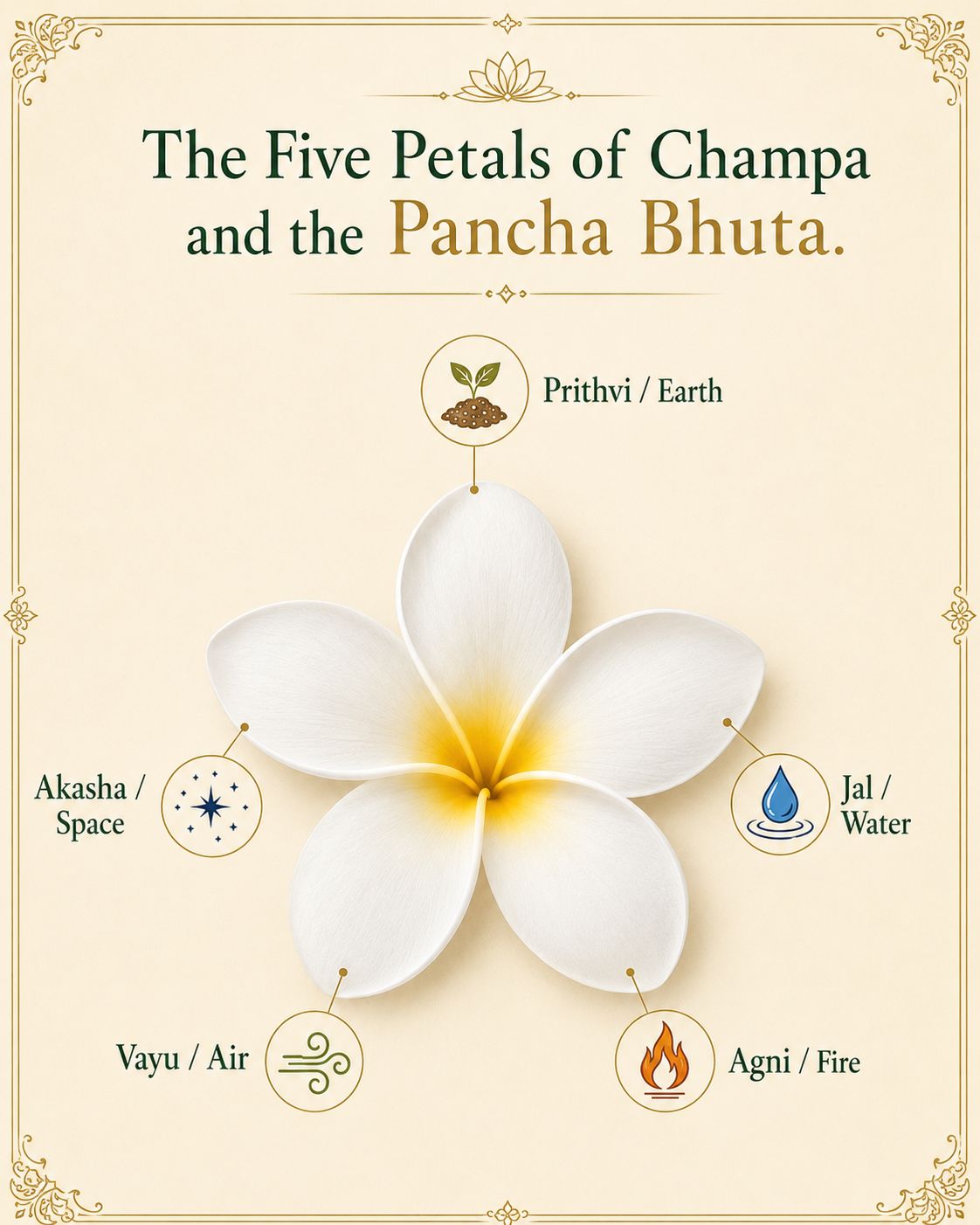
Every Plumeria flower has exactly five petals. In Hindu philosophy, that number is significant, and not by accident.
The five petals are said to represent the Pancha Bhuta, the five elements of existence:
Plumeria Trees Are Planted Near Temples Across India
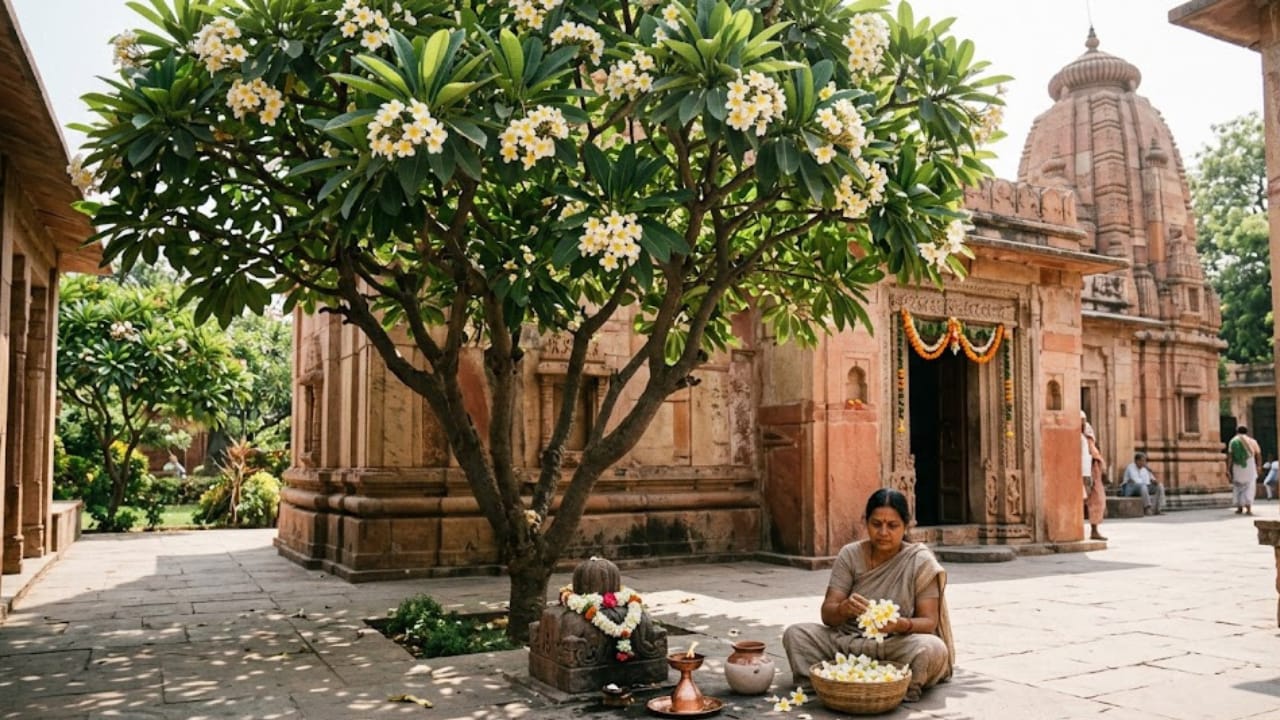
Plumeria trees have been planted near temples across India for centuries because they are deeply connected to worship and sacred spaces.
The tree blooms during most major Hindu festival seasons, providing a steady supply of flowers for rituals and offerings. Its flowers fall naturally from the branches, allowing devotees to collect them without harming the plant, a practice closely aligned with ahimsa. The fragrance of Champa fills temple courtyards with a natural scent that many believe creates a peaceful and spiritually uplifting atmosphere for prayer and meditation.
From Tamil Nadu to Rajasthan, the presence of Champa trees near temples remains one of the most enduring symbols of devotion in Indian culture.
Champa Blooms Exactly When India's Festivals Begin
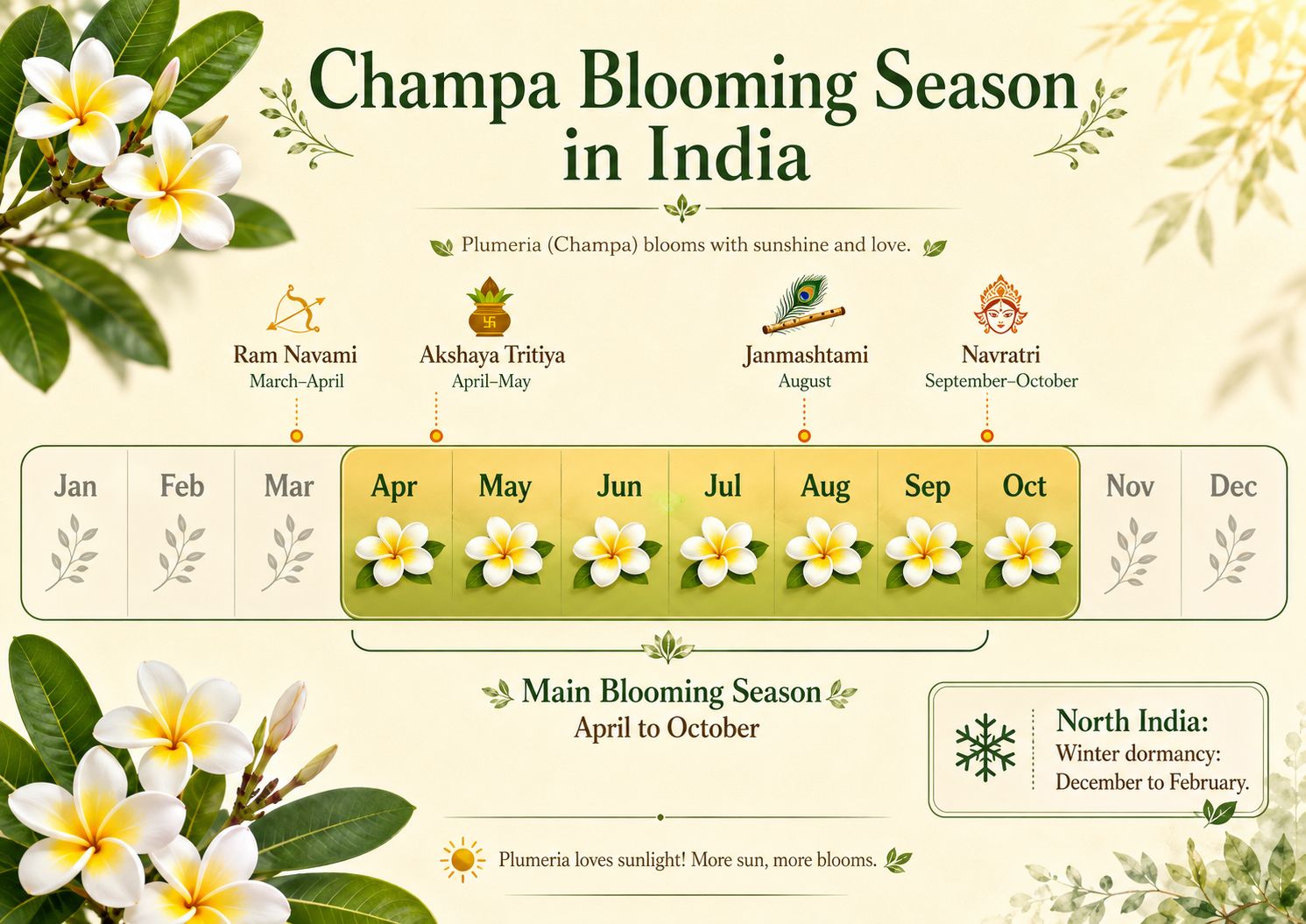
In most parts of India, Plumeria blooms from April through October. That is the peak flowering window, covering summer, pre-monsoon, and post-monsoon months.
In South India, where temperatures stay warm longer, the plant can produce flowers almost throughout the year with only brief pauses. In North India, expect dormancy from December through February. During this period, the leaves fall, the branches look bare, and the plant appears lifeless. It is not. It is resting.
This is important for new plant owners to understand: a dormant Plumeria in winter is healthy. Do not overwater it, trying to revive it. Do not assume it has died. Wait for March. It will return.
The alignment of the bloom season with India's major festivals is striking. Ram Navami, Akshaya Tritiya, Janmashtami, and Navratri all fall within the months when Champa is in full flower. Whether you see this as natural timing or something more, the result is the same. When the temples need flowers, the Champa tree delivers.
Champa Belongs in Every Indian Home Garden
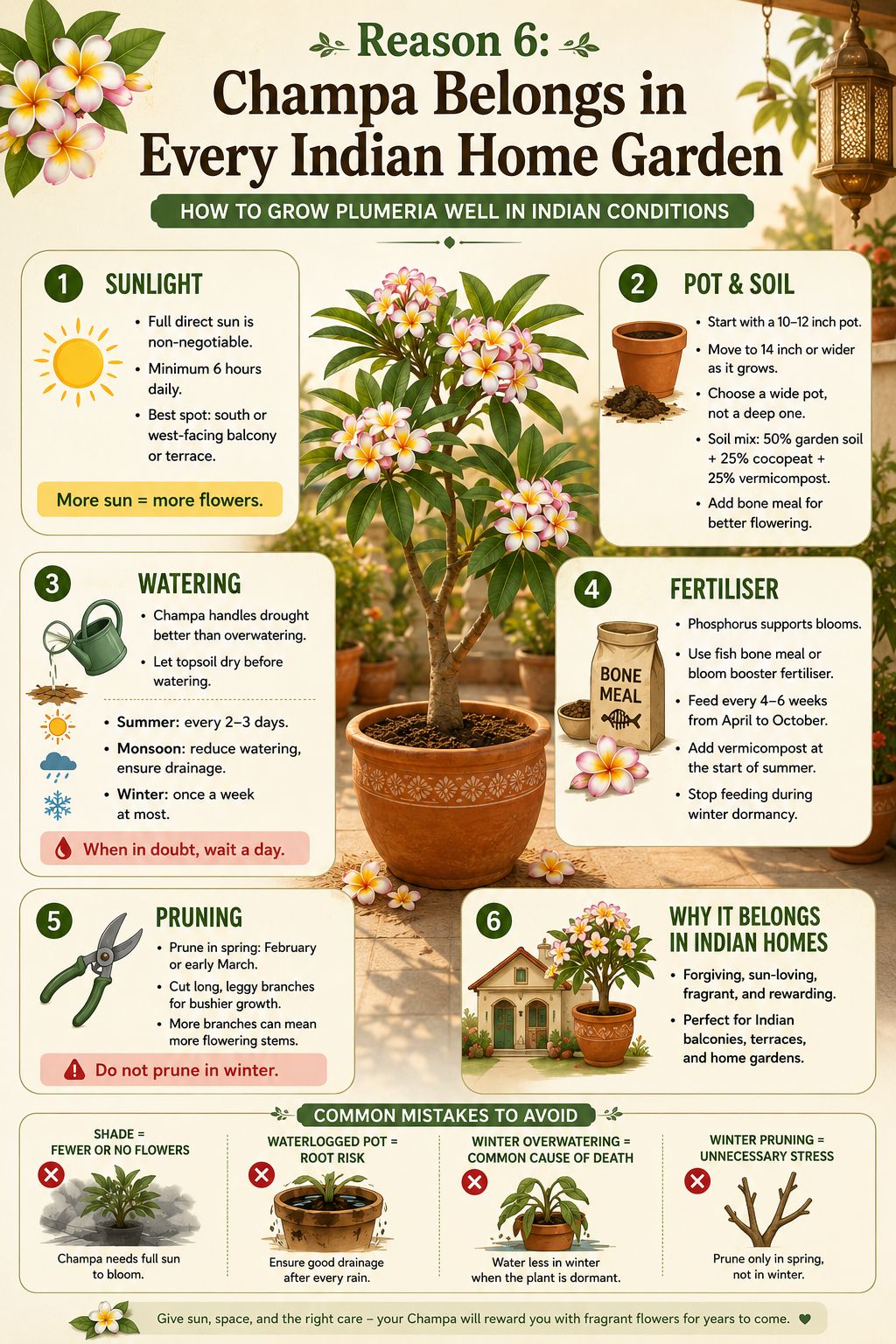
Champa is one of the most rewarding plants for Indian homes, and one of the most forgiving. Here is how to grow plumeria well in Indian conditions.
Sunlight
Plumeria needs full, direct sun. Minimum six hours a day, the more the better. This is non-negotiable. A Champa in shade will survive but will not flower. Place it on a south or west-facing balcony or terrace where it gets uninterrupted sun through the day.
More sun means more flowers. That is the one rule you cannot compromise on.
Pot and Soil
Start with a 10 to 12-inch pot. As the plant grows, move to a 14-inch or wider pot. Plumeria has shallow roots. It spreads wide rather than deep, so choose a wide pot over a deep one.
The soil mix must drain well. A good mix for Indian conditions is 50% garden soil, 25% cocopeat, and 25% vermicompost. Add bone meal if available. It provides the phosphorus that drives flowering. If the pot holds water after rain, your plant is at risk.
Watering
Champa tolerates drought better than it tolerates overwatering. Let the top layer of soil dry out before watering again.
In summer, water every two to three days. During the monsoon, reduce the frequency and make sure the pot drains properly after rain. In winter dormancy, water once a week at most, sometimes less. Most Champa deaths in India happen in winter from overwatering a dormant plant.
When in doubt, wait a day before watering.
Fertiliser
Plumeria is a flowering plant and needs feeding. Phosphorus is the key nutrient. It drives bloom production. Fish bone meal is an excellent natural source. A general bloom booster fertiliser also works well.
Feed every four to six weeks during the growing season (April through October). Add a handful of vermicompost to the pot at the start of summer. Stop fertilising once dormancy begins in winter.
Pruning
Prune in spring, February or early March, just before new growth starts. Cut back long, leggy branches to encourage bushier growth and more flowering stems. Each cut point can produce multiple new branches, and each new branch is a potential flowering stem.
Do not prune in winter. The plant is dormant, and pruning at this stage adds unnecessary stress.
Bring the Sacred Fragrance of Champa Into Your Home
The Champa tree is not something you simply plant in a corner and forget. It is something you notice, the morning it puts out its first blossom of the season, the evenings when the fragrance drifts in through an open window, the day a flower falls at your feet just when you needed it.
In temples across India, this has been happening for centuries. There is no reason it cannot happen in your home, too.
Ready to bring this sacred plant home?
Urvann delivers fresh, healthy Champa plants in multiple varieties directly to your doorstep, the next day.
Shop Champa Plants on Urvann →Frequently Asked Questions
1. What is Plumeria called in India?
Plumeria is known by different names across India. In Hindi and most of North India, it is called Champa. In Telugu and Kannada, it is Sampangi. In Marathi, it is Chafa. In Tamil, it is Chembakam. The Plumeria pudica variety is called Nag Champa in several regions. Internationally, the same plant is known as Frangipani.
2. What is the English name of the Champa flower?
The common English name is Frangipani. The botanical name is Plumeria. In Indian English, it is also widely called Temple Tree. It is a name that reflects its long association with places of worship across the subcontinent.
3. What is the scientific name of Champa?
The most common variety in India, with pink and red flowers, is Plumeria rubra. The white-flowered variety is Plumeria alba. The Nag Champa variety with spoon-shaped leaves is Plumeria pudica.
4. Is Plumeria a lucky plant?
In Hindu tradition, yes. Plumeria is considered auspicious and is believed to bring positive energy to the spaces where it grows. Planting it near a home or garden entrance is considered a sign of good fortune and divine favour.
5. What are the different types of Plumeria found in India?
The three most common in India are Plumeria rubra (pink, red, and multicoloured flowers), Plumeria alba (white flowers, strong fragrance), and Plumeria pudica, the Nag Champa, which has distinctive paddle-shaped leaves and white flowers with yellow centres. All three are suited to Indian conditions.
6. How long does it take for Champa to flower?
Plants grown from cuttings, like those available from Urvann, can flower within the first year under good conditions. Plants grown from seeds take two to three years before they produce their first blooms.
7. Can Plumeria be grown in pots in India?
Yes, and it grows very well in pots on Indian terraces and balconies. Because Plumeria has shallow roots, wide containers work better than deep ones. Give it full sun, well-draining soil, and phosphorus-rich fertiliser during the growing season, and it will flower reliably every year.
8. Why does my Champa plant look unhealthy?
Most Champa plant problems in Indian conditions are caused by overwatering. Wrinkled or soft stems usually indicate excess water or cold damage, while leaf spots are often fungal infections that appear during the monsoon or winter. If the plant has healthy leaves but no flowers, it usually needs more direct sunlight or additional phosphorus through bone meal or bloom booster fertiliser. White cotton-like patches on stems or leaf joints are typically mealybugs and can be treated with diluted neem oil. In most cases, reducing watering and improving sunlight solves the majority of Champa plant issues.