


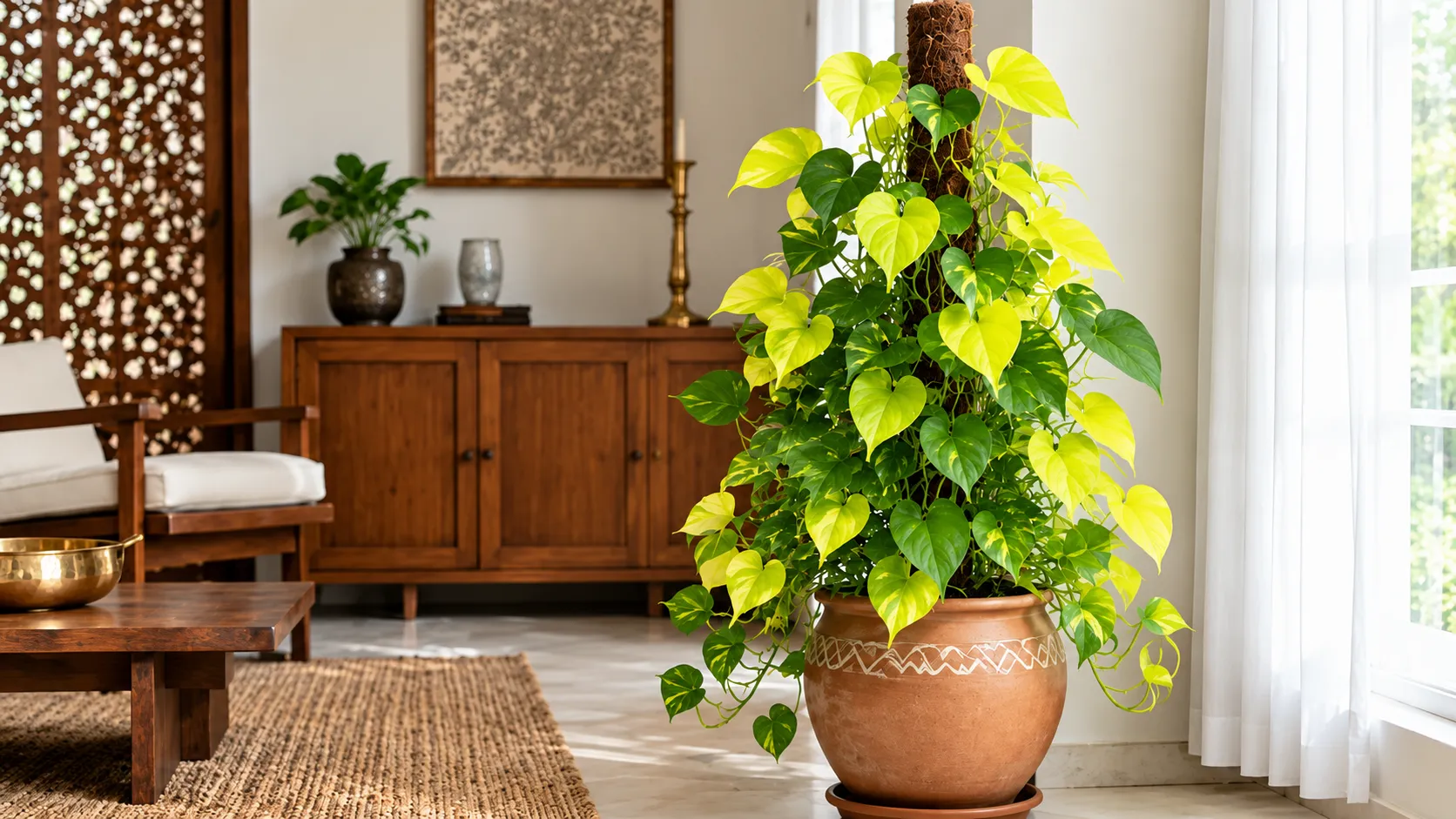
Understand the golden money plant care, Vastu direction, benefits, placement, watering, and growing tips for healthy, vibrant plants at home.
Key Takeaways
- Light matters most. Fading variegation, leggy growth, and small leaves usually come from low light. Fix the light first.
- A southeast spot can support both Vastu beliefs and the bright, indirect light the plant needs.
- Overwatering is more common than underwatering. Mushy stems and yellow lower leaves often signal too much water.
- Soil encourages bigger, bushier growth, while water works well for a compact, low-maintenance display.
- Green or yellow leaves will not regain their original colour. Improvements appear in new growth.
- Pruning vine tips just above a node can encourage fuller, bushier growth.
- The plant is easy to care for, but it still needs enough light and regular watering.
- Money plants have mild toxicity, so keep them away from pets and children.
The golden money plant is probably the most forgiving houseplant you will ever own.
- It grows in soil.
- It grows in water.
- It can grow in a glass bottle on your kitchen windowsill.
- It can survive weeks of neglect and still push out new leaves.
But here is what most people get wrong. They buy a golden money plant and:
- Put it in a random corner.
- Water it whenever they remember.
- Give it too little light, causing the golden variegation to fade.
- Let the vines become long and leggy with tiny leaves.
Then they wonder why their plant has lost its golden colour or isn't growing thick and bushy.
This guide covers everything you need to know about the golden money plant:
- What it actually does for your home, beyond looking good.
- Where to place it according to Vastu.
- How to care for it so the golden variegation stays vibrant.
- How to grow it in both soil and water.
What Is a Golden Money Plant?
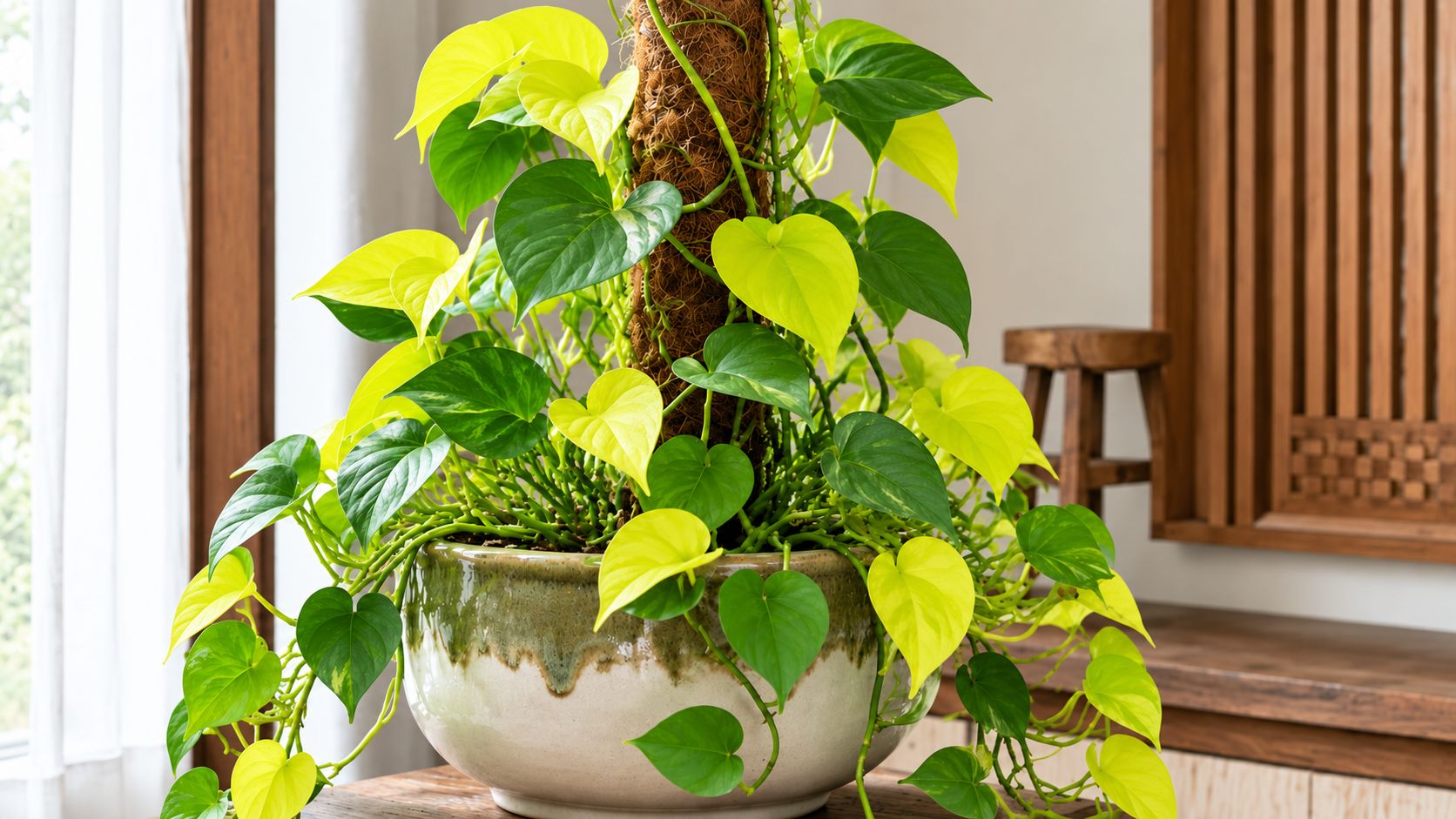
The golden money plant (Epipremnum aureum) is a variety of pothos with heart-shaped leaves marked by golden-yellow streaks and patches against a bright green base. It is also known as:
- Golden pothos
- Devil's ivy
- Money plant, as it is commonly called in Indian households
It belongs to the Araceae family and is native to Southeast Asia. In the wild, it climbs trees using aerial roots and can grow leaves larger than a dinner plate.
Why Is It Called a Golden Money Plant?
The "golden" in its name refers to the yellow variegation on its leaves. This is what makes it visually different from the plain green money plant.
However, that golden colour is not permanent by default. It depends largely on the amount of indirect light the plant receives.
In low light:
- The golden streaks gradually become less visible.
- New leaves may develop less variegation.
- The plant can eventually produce mostly green leaves.
- This happens because the plant produces more chlorophyll to compensate for reduced light.
This loss of golden variegation is one of the most common disappointments for new plant owners and one of the key care points this guide addresses.
Benefits of Golden Money Plant at Home
1. Air Purification
The golden money plant can help filter certain indoor air pollutants. It has been studied for its ability to absorb volatile organic compounds (VOCs), including:
- Formaldehyde, which can be released from furniture, paint, and plywood.
- Benzene, which can be found in some detergents and plastics.
- Carbon monoxide.
However, houseplants should not replace proper ventilation or air purifiers. Their real-world impact on indoor air quality in typical homes is limited.
2. Natural Humidity
The golden money plant releases moisture through its leaves through transpiration. This can add a small amount of humidity to the surrounding air, particularly in:
- Air-conditioned rooms
- Dry indoor spaces
- Homes during dry winters
However, it is not a substitute for an electric humidifier when you need to significantly increase room humidity.
3. Low Light Tolerance
The golden money plant tolerates lower light better than many houseplants, making it suitable for spaces such as:
- Hallways
- Bathrooms with some natural light
- Office cubicles
- Interior rooms
- Rooms with limited window space
It can survive in low light, but complete darkness will not support healthy growth. Brighter indirect light is also important if you want to maintain its golden variegation.
4. Stress Reduction
Research on interacting with indoor plants has linked plant care and exposure to greenery with reduced psychological and physiological stress.
Simple activities such as:
- Watering the plant
- Pruning overgrown vines
- Watching new leaves unfurl
- Spending time around greenery
can provide a small, calming break during the day.
5. Aesthetic Versatility
The golden money plant works well in a variety of spaces and can be displayed in several ways:
- Hanging baskets: Let the vines trail down naturally.
- Shelves: Allow the foliage to cascade over the edges.
- Moss sticks: Train the plant to climb vertically.
- Wall-mounted trellises: Create a living green display.
- Glass jars: Grow it in water on kitchen counters or desks.
- Ceramic pots: Add greenery to study tables and living rooms.
- Balcony railings: Let the vines trail along the railing.
Its combination of attractive variegated leaves, flexible growth habits, and relatively easy care makes it a practical choice for indoor spaces.
Golden Money Plant Vastu: Direction, Placement and Tips
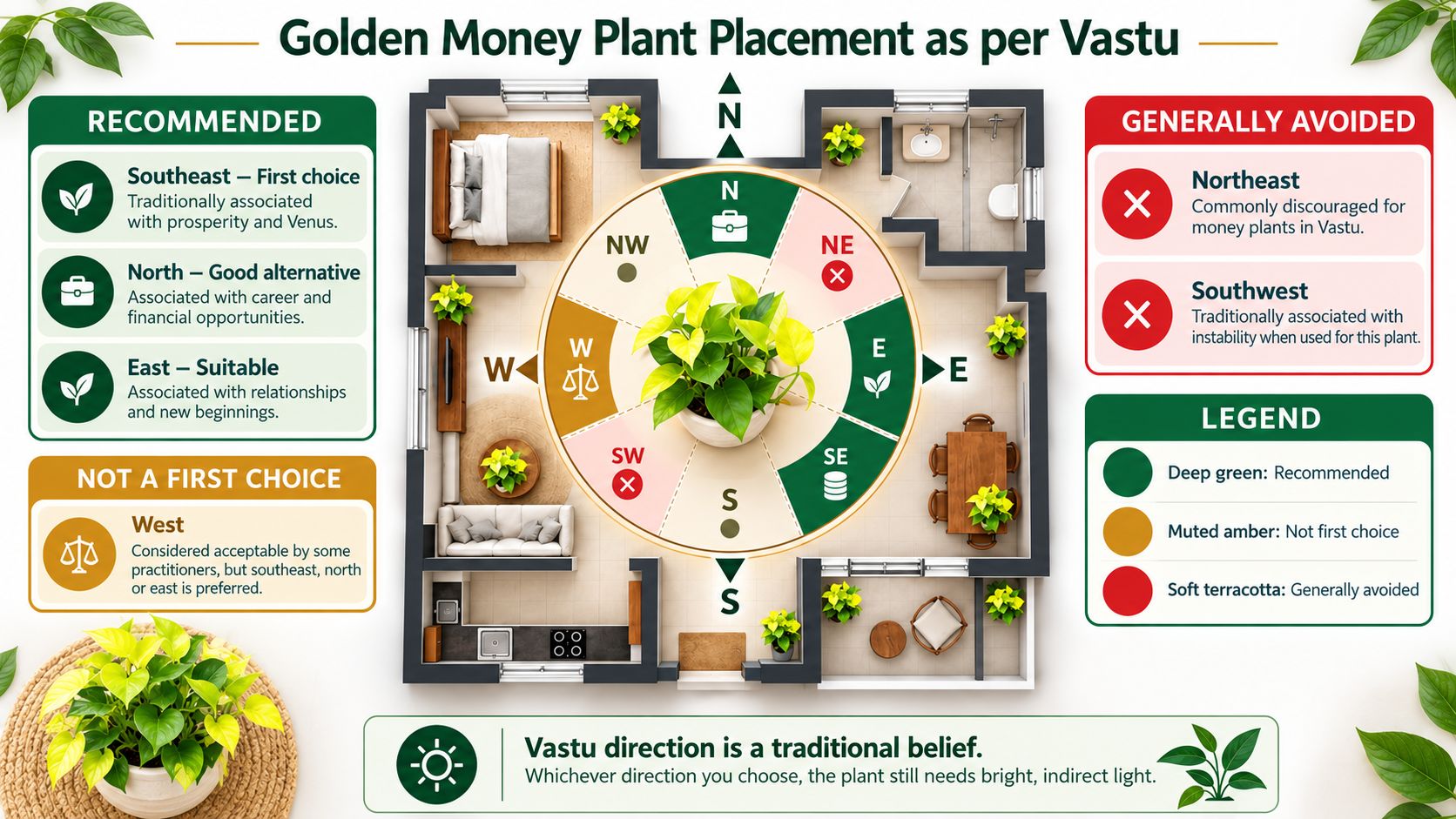
In Indian culture, the golden money plant carries significance beyond aesthetics. Vastu Shastra associates this plant with the planet Venus (Shukra), which governs wealth, comfort, and material prosperity. Proper placement as per Vastu is believed to activate positive energy flow and attract financial stability.
Here is a room-by-room and direction-by-direction guide.
Best Directions for Placing a Golden Money Plant
Southeast (Best for Wealth)
The southeast corner is ruled by Venus and is associated with Goddess Lakshmi and Lord Ganesha in Vastu. Placing a golden money plant here is considered the most auspicious position for attracting financial prosperity. If you can only pick one spot in your home, make it the southeast corner of your living room.
North (Good for Career and New Opportunities)
The north direction is governed by Kubera, the god of wealth. Placing a money plant here is believed to support career growth and open new income streams. Vastu practitioners recommend using a blue or green pot for plants in the north direction.
East (Supports Relationships and New Beginnings)
The east is considered universally auspicious for indoor plants. A golden money plant placed here is believed to help with personal relationships and creating new opportunities. A green pot works well in this direction.
Directions to Avoid
Northeast
This is one of the most commonly cautioned directions in Vastu for money plants. Placing the plant here is believed to block financial growth and may attract negative energy. If your money plant is currently in the northeast corner, consider moving it.
Southwest
Placing a money plant in the southwest can create instability in relationships and professional life, according to Vastu. This direction is generally not recommended for any indoor plants.
West
While not as strongly cautioned as northeast, the west is not ideal for money plants either. Some Vastu experts note that if the plant grows well and climbs upward in the west direction, it can be acceptable, but it is not a recommended first choice.
Room-by-Room Placement
Living Room
The most popular and Vastu-recommended location. Place the plant in the southeast corner of the living room. If that corner does not receive any light, the north or east side of the room works as an alternative. Many families also place a small golden money plant inside a tabletop aquarium facing the southeast direction.
Bedroom
A money plant can be placed in the bedroom, but Vastu recommends keeping it at least five feet away from the head and foot of the bed. The plant releases carbon dioxide at night (like all plants), and keeping it too close to the sleeping area may cause minor discomfort for sensitive sleepers. The southeast corner of the bedroom is the ideal spot.
Kitchen
Place the golden money plant near a window or entrance in the kitchen. Keep it at least four feet away from the stove and any direct heat source. The kitchen window is often one of the best light sources in Indian apartments, making it a practical choice for the plant's health as well.
Bathroom
The golden money plant thrives in bathrooms because of the naturally high humidity. As per Vastu, place it on the southeast side of the bathroom, ideally near a window that provides some indirect light. The humid environment helps the plant maintain lush, healthy foliage with minimal watering. For homes where bathroom windows are small or absent, the plant will survive for extended periods but should be rotated to a brighter spot every few weeks.
Near Electronics
Money plants are believed to absorb electromagnetic radiation when placed near Wi-Fi routers, televisions, and computer screens. While the scientific evidence for radiation absorption is limited, the air-purifying properties of the plant do benefit rooms with heavy electronic use.
General Vastu Tips
- Let the vines grow upward rather than trailing downward. Upward growth symbolises progress and prosperity.
- Never let the vines touch the floor. Use hooks, clips, or a small trellis to guide them along the wall or upward on a support.
- Keep the plant healthy and green. A dying or yellowing money plant is considered inauspicious in Vastu. Remove yellow leaves promptly.
- Keep the plant indoors. Vastu recommends that money plants remain inside the home. Placing them outdoors in direct sun, apart from being bad for the plant's health, is also considered to diminish their Vastu benefits.
- Do not give your money plant away to others. In Vastu tradition, handing over your money plant to someone else is believed to transfer your financial luck to them.
How to Care for a Golden Money Plant
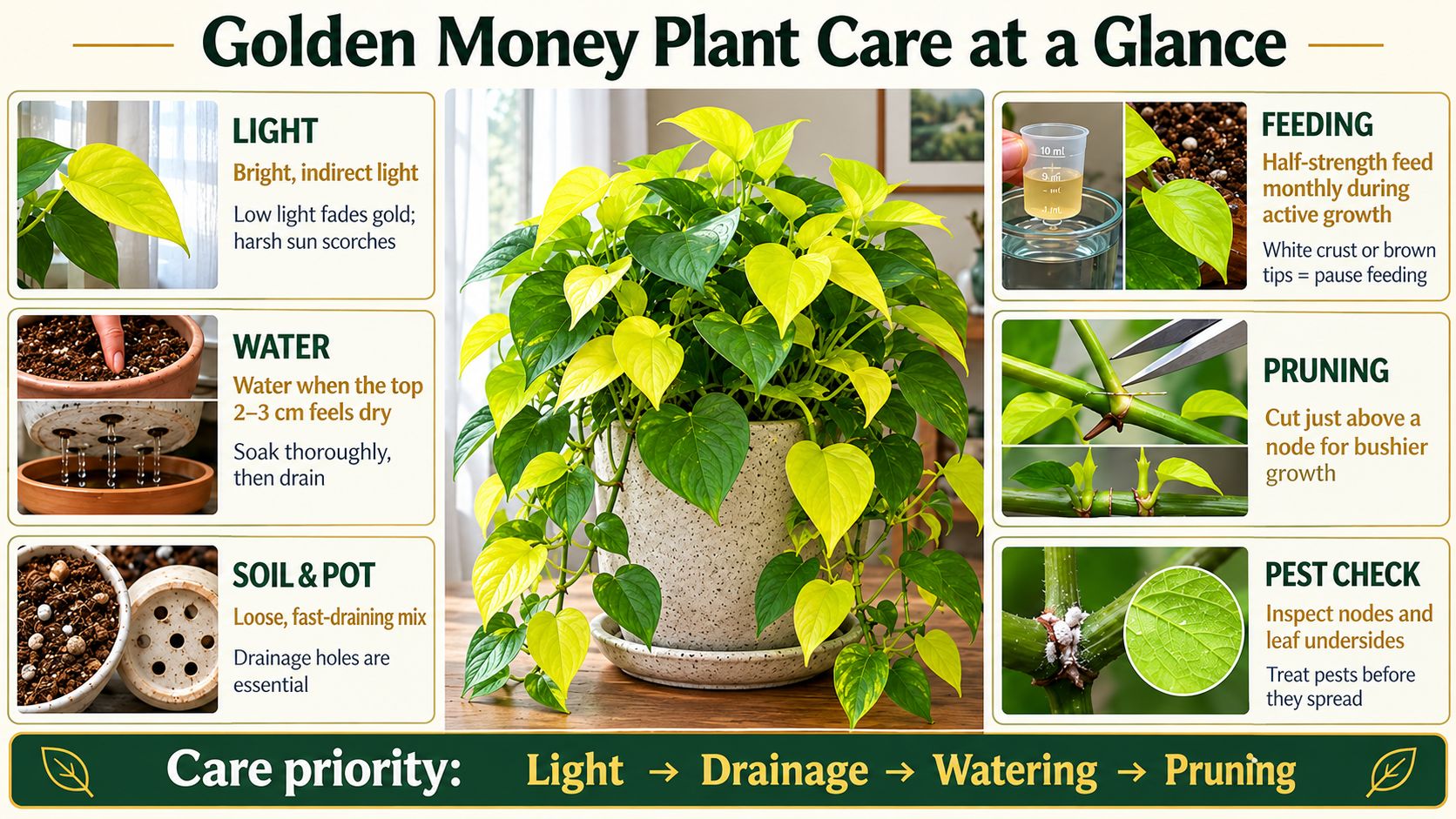
The golden money plant is famously hard to kill, but there is a significant difference between a plant that is merely surviving and one that is thriving with thick vines, large leaves, and vivid golden variegation. Here is how to achieve the latter.
Light
Light is the single most important factor for maintaining the golden colour.
The golden money plant needs bright, indirect light to keep its variegation. Place it near a window where it receives filtered sunlight for several hours a day.
- East-facing windows: Gentle morning light makes them a good option.
- North-facing windows: Usually provide softer light throughout the day.
- Low-light spaces: The plant can survive, but its leaves may gradually turn greener.
- Direct afternoon sunlight: Avoid it, especially during Indian summers, as harsh sunlight can scorch the leaves.
If your golden money plant has lost its variegation, move it to a brighter spot. New leaves produced after the move should develop stronger golden markings.
Watering
Overwatering kills more money plants than neglect does. The golden money plant prefers its soil to dry out partially between waterings.
Before watering:
- Push your finger about an inch into the soil.
- If the soil feels dry, water thoroughly until water drains from the bottom.
- If it still feels moist, wait another day or two.
Watering frequency varies with the weather and growing conditions, but as a general guide:
- Summer: Around once every 4 to 5 days.
- Winter: Around once every 7 to 10 days.
- Monsoon: Water less frequently because humidity keeps the soil moist for longer.
Watch for these signs of overwatering:
- Yellowing leaves, especially older lower leaves.
- Mushy stems near the base.
- A sour smell from the soil.
If you notice these signs, stop watering and check the roots. Remove black or mushy roots with clean scissors and repot the plant in fresh, well-draining soil.
Signs of underwatering include:
- Drooping or wilting leaves.
- Leaves that perk up within a few hours of watering.
- Dry, crispy leaf edges.
Soil
The golden money plant is not fussy about soil, but a well-draining mix can make a noticeable difference in growth and root health.
A simple potting mix is:
- 1 part garden soil for structure.
- 1 part cocopeat for moisture retention and aeration.
- 1 part vermicompost for nutrients.
If you are using a ready-made potting mix:
- Make sure it drains freely.
- If water sits on the surface for more than a few seconds after watering, the mix may be too dense.
- Add cocopeat or perlite to improve drainage.
Most importantly, always use a pot with drainage holes. Without proper drainage, excess water can accumulate around the roots and increase the risk of root rot.
Fertilizing
Feed the golden money plant once a month during its active growing season, roughly March to September in most of India.
You can fertilize it using:
- Balanced liquid fertilizer: Dilute it to half strength and apply once a month.
- Vermicompost: Add a thin layer to the top of the soil.
During winter, roughly November to February, stop fertilizing as the plant's growth naturally slows.
Avoid over-fertilizing, as it can cause salt buildup in the soil. Signs include:
- White crust forming on the soil surface.
- Brown tips on the leaves.
If you notice these signs:
- Flush the soil several times with clean water.
- Stop fertilizing for at least 6 weeks.
Pruning
Regular pruning is the key to growing a bushy golden money plant instead of a long, leggy one.
When you cut the tip of a vine, the plant can produce new growth from a lower node. This encourages branching and makes the plant look fuller over time.
For best results:
- Prune during the growing season when the plant is actively growing.
- Use clean, sharp scissors to make clean cuts.
- Cut just above a leaf node, the small bump on the stem where a leaf emerges.
- Propagate healthy cuttings to grow new golden money plants.
- Remove fully yellow leaves because they will not recover, and removing them helps redirect the plant's resources toward healthy growth.
Pest Management
Golden money plants are generally pest-resistant, but indoor conditions can occasionally attract pests such as:
- Mealybugs: White, cottony clusters on stems and leaf joints.
- Aphids: Tiny green or black insects, usually found on new growth.
For small infestations:
- Dip a cotton swab in rubbing alcohol.
- Gently wipe the affected areas.
- Repeat as needed until the pests are gone.
For larger infestations:
- Mix 5 ml neem oil with 1 litre of water and add a drop of liquid soap.
- Spray the solution over the plant, including the undersides of the leaves.
- Repeat every 5 to 7 days until the infestation is under control.
You can also inspect the plant regularly during warm, humid weather to catch pests early.
How to Grow Golden Money Plant in Water
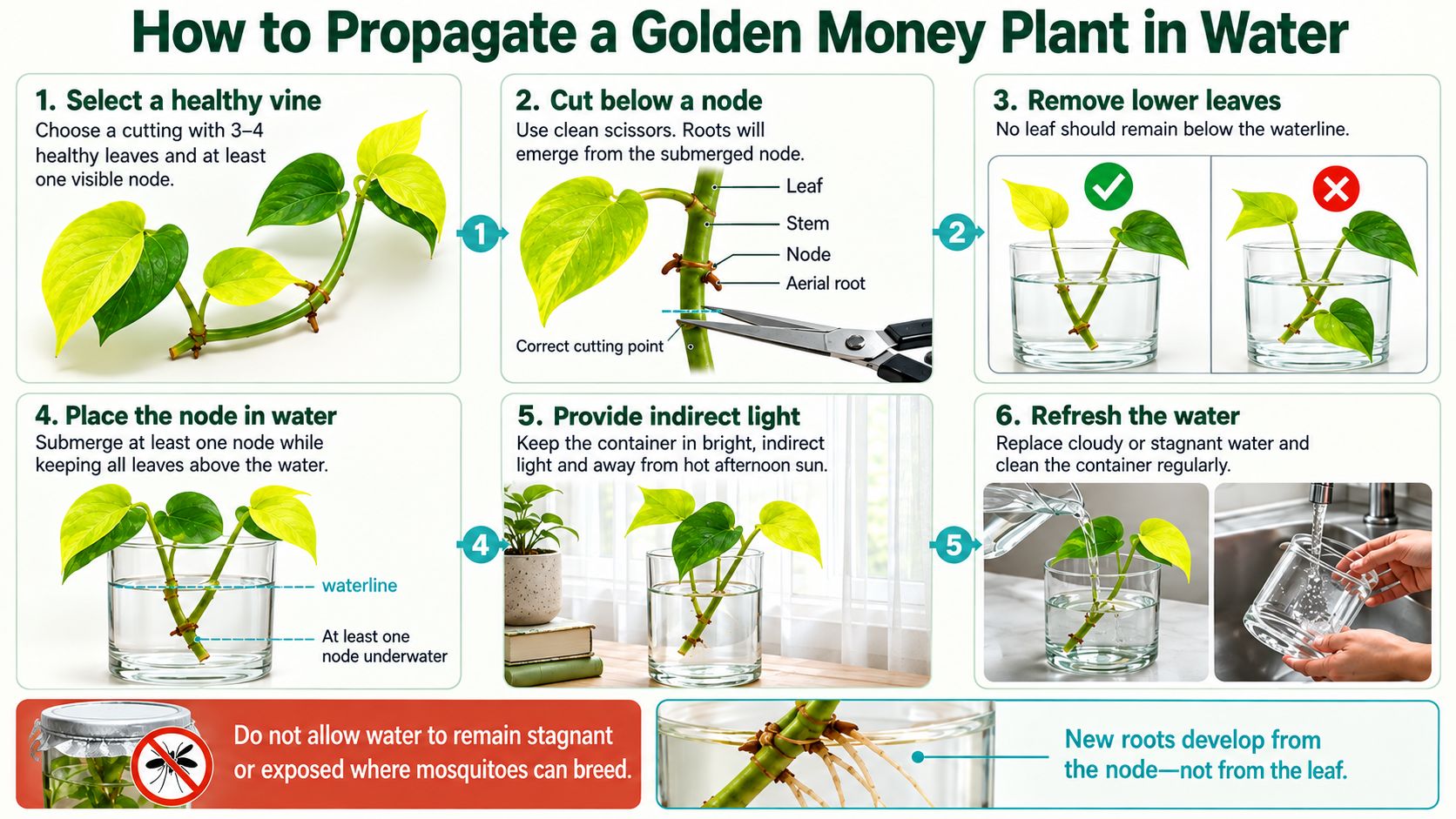
Growing a golden money plant in water is one of the easiest ways to bring greenery into your home without dealing with soil, pots, or drainage.
Step-by-Step
Take a Healthy Cutting
Select a vine with at least 3 to 4 healthy leaves. Cut just below a node (the small bump on the stem where aerial roots emerge). The node is where new roots will grow.
Remove Lower Leaves
Strip off any leaves that would sit below the waterline. Submerged leaves rot and contaminate the water.
Choose the Right Container
A clear glass jar, bottle, or vase works well. The transparency lets you monitor root growth and water clarity. Decorative glass bottles on kitchen windowsills or bookshelves are a popular styling choice in Indian homes.
Use Clean Water
Fill the container with filtered or tap water that has been left to sit for 24 hours (this lets the chlorine dissipate). RO water works too. Avoid using water straight from the tap if your area has a heavily chlorinated supply.
Place in Bright, Indirect Light
A windowsill that gets morning light is ideal. Avoid direct afternoon sun, which heats the water and promotes algae growth.
Change the Water Regularly
Replace the water completely once every 7 to 10 days. This prevents stagnation, mosquito larvae (important during Indian monsoons), and fungal growth. When changing water, rinse the roots gently under running water to remove any slime.
Can You Fertilize Money Plants Growing in Water?
You can add a few drops of liquid fertilizer to the water once a month during the growing season. Use it at one-quarter of the recommended soil-application strength. Too much fertilizer in water promotes algae and can damage the roots. If you see green algae forming on the inside of the glass, reduce or stop the fertilizer and change the water more frequently.
Water vs. Soil: Which Is Better?
Both water and soil work for growing a golden money plant, but each has different advantages.
| Growing in Soil | Growing in Water |
|---|---|
| Faster growth | Slower growth |
| Larger leaves | Usually smaller leaves |
| Bushier growth | More compact growth |
| Better for large plants | Easier for decorative displays |
| Suitable for moss sticks and shelves | Ideal for glass jars and bottles |
Choose soil if you want:
- A large, bushy plant.
- Bigger leaves and faster growth.
- A plant climbing a moss stick.
- Long vines trailing from a high shelf.
Choose water if you want:
- A compact decorative plant.
- A glass jar on your desk.
- A bottle on your kitchen counter.
- An easy way to grow and display cuttings.
Can You Move a Money Plant From Water to Soil?
Yes, but the transition should be gradual. Roots grown in water adapt differently from roots grown in soil.
When transferring a water-grown cutting:
- Plant it in a loose, well-draining potting mix.
- Keep the soil consistently moist for the first 2 to 3 weeks.
- Avoid keeping the soil waterlogged.
- Gradually allow the soil to dry slightly between waterings as new soil-adapted roots develop.
Common Problems and How to Fix Them
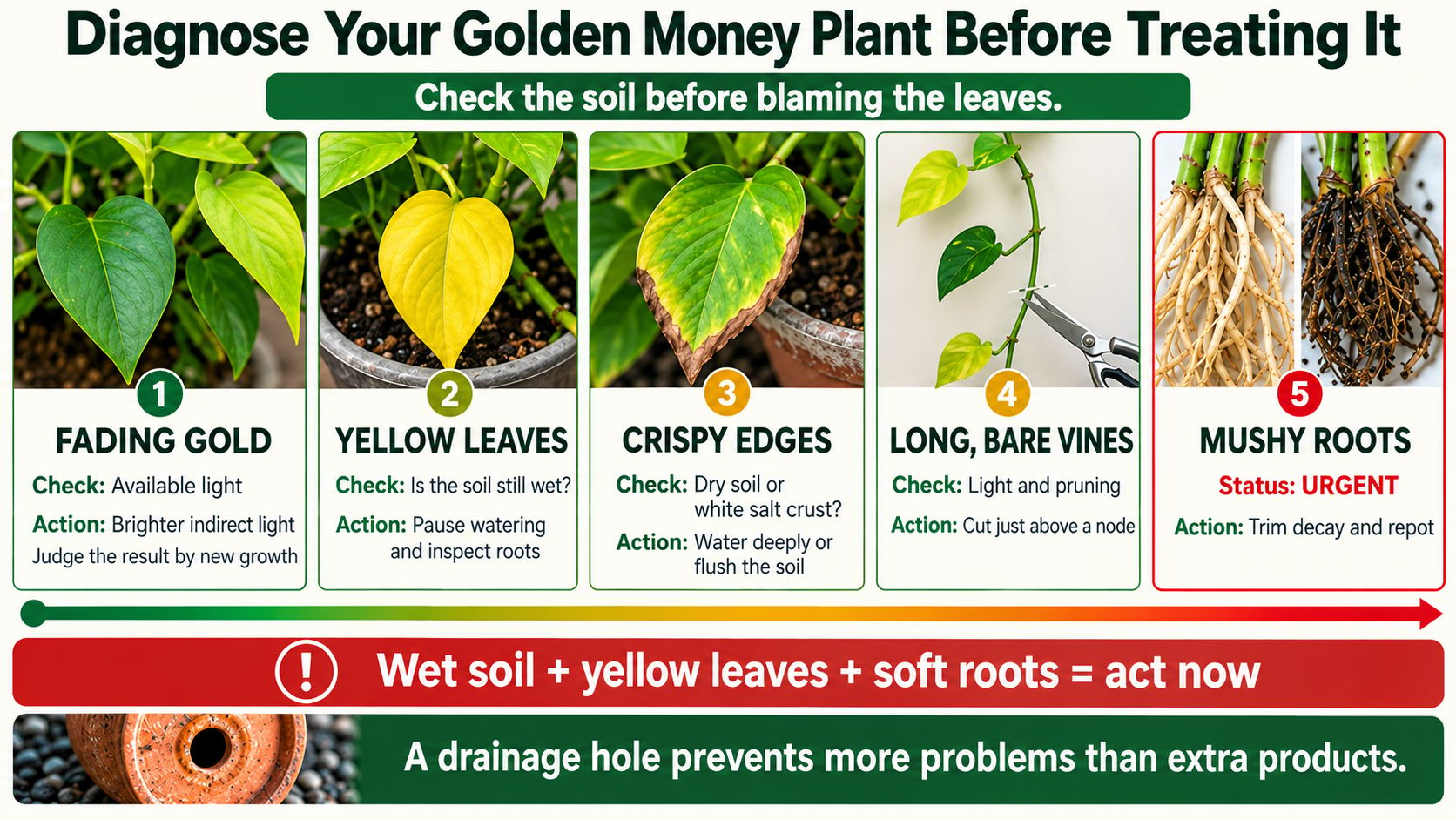
Leaves Losing Golden Colour
- Cause: Insufficient light. The plant produces more chlorophyll in low light, which masks the golden pigment.
- Fix: Move the plant to a brighter spot with indirect light. New leaves will show stronger variegation. Old green leaves will not revert to golden.
Yellow Leaves
- Cause: Usually overwatering. Can also be caused by root rot, nutrient deficiency, or natural aging of older leaves.
- Fix: Check the soil moisture before watering. If roots are mushy and brown, trim the damaged roots, let the plant dry out, and repot in fresh soil.
Brown, Crispy Leaf Edges
- Cause: Underwatering, extremely dry air (common in AC rooms), or salt buildup from over-fertilizing.
- Fix: Water more consistently. Mist the leaves occasionally in dry weather. If salt buildup is visible on the soil, flush with water.
Leggy Growth with Small Leaves
- Cause: Low light combined with infrequent pruning.
- Fix: Move to brighter light and prune the long, bare vines. Cut just above a node. The plant will branch out from below the cut.
Root Rot
- Cause: Overwatering in a pot without proper drainage, or soil that retains too much moisture.
- Fix: Remove the plant from the pot, trim all black or mushy roots, let the remaining healthy roots air-dry for a few hours, and repot in fresh, well-draining potting mix in a pot with drainage holes.
How to Style a Golden Money Plant at Home

The golden money plant adapts to almost any display method, which is part of its appeal. Here are the most popular ways Indian homes use it.
1. Hanging Baskets
Trail the vines down from a balcony railing, a ceiling hook in the living room, or a high shelf. The cascading golden-green foliage creates a natural curtain effect.
2. Moss Stick Climber
Insert a moss stick into a large pot and train the vines to climb upward using soft ties. As the aerial roots attach to the moist moss, the leaves grow progressively larger. This is how you get the dramatic, large-leaved look that makes a golden money plant a true statement piece.
3. Glass Jars and Bottles
A single cutting in a transparent glass bottle on a kitchen counter or study desk is one of the simplest ways to add greenery to small spaces. Add pebbles or coloured stones to the bottom for a decorative touch.
4. Wall-Mounted Trellises and Frames
Attach a small wooden or metal trellis to a wall and guide the vines across it. This creates a living wall art effect without the cost or complexity of a full vertical garden.
5. Window Placement
Place the pot on a windowsill and let the vines trail along the window frame. The golden leaves catch the light beautifully, and the plant benefits from the indirect sunlight.
Where to Buy a Healthy Golden Money Plant
If your golden money plant has lost its variegation or become leggy, starting with a healthy, well-rooted plant may be easier than reviving an old vine.
Urvann's golden money plant collection includes:
- Nursery-pot plants: Available in 4-inch, 5-inch, and 6-inch sizes for repotting into your own container.
- Moss stick climbers: Pre-trained golden money plants for a large-leaved, mature look.
- Hanging baskets: Available with N'Joy, marble, and green money plant varieties.
- Designer pots: Ceramic and plastic pots in different colors.
- Gift-ready arrangements: Golden money plants in decorative pots.
- Multi-plant sets: Combinations of golden, green, white, N'Joy, and marble varieties.
Choose a reliable source with fast delivery to help the plant arrive healthy and maintain its variegation.
Frequently Asked Questions
Which direction should a money plant face as per Vastu?
The southeast corner of your home is considered the best direction for placing a golden money plant. This direction is associated with Venus and Goddess Lakshmi, and is believed to activate wealth and prosperity. The north direction is the second-best option, associated with Kubera (the god of wealth) and good for career growth.
Where should you not keep a money plant?
Avoid placing a money plant in the northeast corner of your home. As per Vastu, this placement can block financial growth and attract negative energy. The southwest direction is also not recommended, as it may create instability in relationships. Additionally, never place a money plant outdoors in direct sunlight, both for Vastu reasons and because harsh sun damages the leaves.
Is golden money plant good for home?
Yes. The golden money plant purifies indoor air, adds natural humidity, tolerates low light, and is considered auspicious in both Vastu and Feng Shui traditions. It is one of the lowest-maintenance houseplants available, making it suitable for beginners, busy households, and homes with limited natural light.
Does golden money plant grow better in water or soil?
Both work, but they produce different results. Soil-grown plants develop faster, produce larger leaves, and grow bushier. Water-grown plants stay compact and are easier to maintain but grow slower. For a full, statement-sized plant, soil is the better choice. For simple, decorative displays in small spaces, water works well.
Can I keep a money plant in the bathroom?
Yes. Bathrooms are actually one of the best spots for a golden money plant because of the naturally high humidity. Place it near a window for some indirect light. The humid environment helps the plant maintain healthy, lush foliage with less frequent watering. If the bathroom has no window, rotate the plant to a brighter room every few weeks.
Why is my golden money plant turning green?
The golden variegation fades when the plant does not get enough light. In low-light conditions, the plant produces more chlorophyll to capture available light, and this extra green pigment overpowers the golden colour. Move the plant to a brighter spot with indirect light. New growth will show stronger golden markings, though already-green leaves will not change back.
How do I make my golden money plant grow faster?
Three things accelerate growth: bright indirect light (the single biggest factor), regular feeding with a balanced fertilizer or vermicompost during the growing season (March to September), and consistent watering that keeps the soil slightly moist without waterlogging. Pruning the vine tips also encourages the plant to branch out and grow bushier rather than long and leggy.
Can I put a money plant in the west direction?
The west direction is not ideal as per Vastu. However, some Vastu practitioners note that if the plant grows well and climbs upward in the west direction, it can be acceptable because west is associated with Saturn, which represents stability. It is not a first-choice placement, though. Southeast, north, or east are all better options.